
Portable Power · US camping guide
A big battery is not automatically the right camping battery. The useful choice is the one that covers your actual devices, fits your vehicle and carrying routine, and has a realistic recharge plan.
Affiliate disclosure: SolOffGrid may earn a commission if you buy through the affiliate link in this guide, at no extra cost to you. This is a documentation-based buying guide, not a hands-on product test or a complete market ranking. Product specifications checked October 5, 2026.
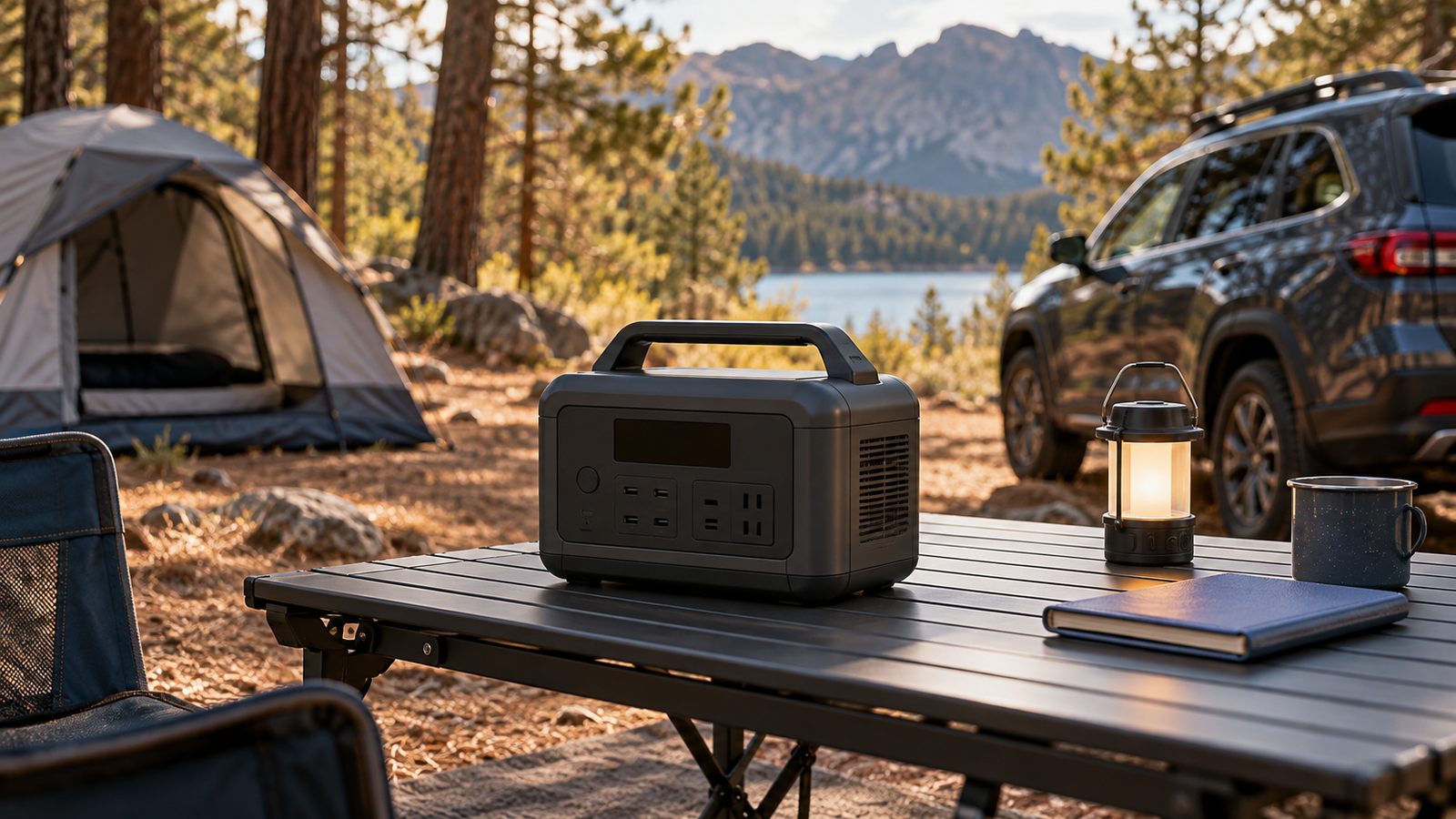
What kind of camping are you planning?
Start with the trip, not a brand name. Carrying a station ten feet from the trunk is different from carrying it down a trail. Count the station, panels, cables and protective gear together when you judge portability.
| Trip or load | First question | What to compare |
|---|---|---|
| Phones, lights and camera charging | Do you need an AC outlet at all? | USB compatibility, charge energy and total carrying weight; a power bank may be enough. |
| Car camping with a fan and laptop | How many hours will each device run? | Energy budget, suitable outputs and whether you can recharge between nights. |
| Camping with a compressor fridge | What does this fridge consume over a full day? | Measured daily energy, starting requirements, connector limits and reserve. |
| Kettle, cooker or electric heater | How much energy will the planned use consume? | Continuous output and watt-hours; passing the power test does not mean long runtime. |
| Walking away from your vehicle | Can you carry the complete kit comfortably? | Weight and dimensions; do not treat a large car-camping station as backpacking equipment. |
How much energy does a two-night camping trip need?
Make a device list. Use measured consumption where possible, and keep energy at the station’s output separate from a device’s internal battery capacity. A charging adapter also has losses.
For a steady load: watts × hours = watt-hours.
For the trip: add the energy of every device, then allow for output losses, standby use and an explicit reserve.
The following numbers are invented planning inputs, not typical consumption figures or a test of any station. Replace them with your own measurements.
| Assumed load | Calculation | Trip energy |
|---|---|---|
| Phone charging, measured at the station output | 25Wh total per day × 2 days | 50Wh |
| LED lights | 5W × 4 hours × 2 nights | 40Wh |
| Small fan | 10W × 6 hours × 2 nights | 120Wh |
| Laptop session | 40W average × 2 hours | 80Wh |
| Total at the outputs | 50 + 40 + 120 + 80 | 290Wh |
For illustration only, if 80% of rated battery energy reached these loads, 290 ÷ 0.80 would require about 363Wh of rated capacity. Adding a 25% planning reserve gives about 453Wh. Neither percentage is a verified efficiency or a universal safety margin. Standby consumption, cold conditions, output choice and the actual devices can change the result.
This example shows why a modest electronics setup does not automatically require a 2kWh station. It does not prove that any particular smaller model will complete your trip.
Watts and watt-hours answer different questions
Watts tell you whether the station can supply a load at that moment. Watt-hours help estimate how long the stored energy may last. Check the continuous AC rating, each USB or DC port’s limits, simultaneous loads and startup requirements separately.
A hypothetical 1,000W appliance running for 15 minutes uses 250Wh before additional losses. A station may have sufficient output power but still use a substantial share of its battery on one short task. A surge rating is not a continuous operating allowance.
What changes when you bring a camping refrigerator?
Do not multiply a compressor’s running wattage by 24 hours and call that a reliable fridge forecast. Conversely, do not assume it runs for only a few hours without evidence. Temperature, settings, contents and use can affect its cycling.
Measure a representative full-day energy total, or use the exact manufacturer’s stated consumption with its test conditions. Include the fridge’s starting and port requirements. In a hypothetical plan, a fridge consuming 300Wh per day would add 600Wh over two days. That would increase the worksheet above from 290Wh to 890Wh before station losses and reserve.
A 12V socket or matching plug alone does not establish compatibility. Check the refrigerator’s voltage, current and connector requirements against the station manual. This guide does not guarantee refrigerated-food temperatures or appliance runtime.
Two documented US product examples: capacity versus carrying weight
These examples illustrate a trade-off, not a claim that Jackery is the best brand. We have not measured their efficiency, noise or campsite performance. Manufacturer figures refer to the exact US models listed, not Pro, Plus or HomePower variants.
| Exact model | Rated capacity | Continuous AC output | Approximate station weight |
|---|---|---|---|
| Jackery Explorer 1000 v2 | 1,070Wh | 1,500W | 23.8lb / 10.8kg |
| Jackery Explorer 2000 v2 | 2,042Wh | 2,200W | 39.5lb / 17.9kg |
Sources: Explorer 1000 v2 US specifications and Explorer 2000 v2 US specifications. These are direct documentation links, not affiliate links. Both pages list LiFePO4 chemistry and 120V/60Hz AC outputs.
The 2000 v2 lists 972Wh more capacity and weighs approximately 15.7lb more. More stored energy may help a larger load plan, but extra weight matters when unloading and carrying. Neither row establishes delivered energy or a particular number of nights.
Check Explorer 2000 v2 US options — affiliate link
We may earn a commission through this link. It leads to the specific 2000 v2 product page. Confirm the selected package, current price, shipping to your address and return terms before buying; panels and accessories depend on the package. No price or stock guarantee is made here.
Do you need a solar panel bundle for a weekend trip?
Begin with the energy you can carry from home. For a short trip with uncertain weather, a plan that works without solar may be simpler than relying on a panel to rescue an undersized battery.
If you want solar charging, check the station’s documented input voltage and current limits, the panel’s specifications, connectors, required adapters and cable arrangement. The panel’s advertised wattage is not a promise of continuous output. Do not assume that a compatible-looking connector establishes electrical compatibility.
Compare the exact contents of a station-only package with a station-and-panel bundle. Include the panel’s folded dimensions and weight in your packing decision. For format choices, read foldable versus portable solar panels.
What should you check before using the station outdoors?
Follow the exact model’s manual for location, ventilation, temperature, charging and moisture limits. A panel’s water-resistance claim does not apply automatically to the battery station. Do not infer waterproofing from a brand name, rugged appearance or an illustration.
Do not assume that battery power is risk-free, silent or suitable for every tent or enclosed space. Keep manufacturer instructions available and check them before your trip. Do not improvise connections to a vehicle or an RV’s fixed electrical system.
US purchase checklist
- Match the exact model and US electrical version to your devices.
- Record expected trip energy and simultaneous power needs separately.
- Check complete-kit weight and the distance from vehicle to campsite.
- Verify every required port, cable and approved adapter.
- Confirm what the selected package includes; “solar generator” does not always mean panels are included.
- Check checkout shipping, tax, warranty conditions and return rules for your address.
- Test your actual devices before leaving, following the manuals; this article is not that test.
- Plan for a failed recharge or higher consumption rather than relying on an optimistic runtime claim.
Frequently asked questions
Is a 500Wh station enough for two nights?
It depends on the load list and delivered energy. The illustrative light-use worksheet suggests why that class might be worth investigating, but a fridge, heating appliance or extra hours of use can change the answer. Calculate your trip rather than buying by the capacity number alone.
Should I buy a bigger station instead of solar panels?
Compare the extra stored energy you can carry with the uncertain energy you can collect at the campsite. Then weigh the whole kit. Neither choice is automatically better; shade, weather, trip duration and access to another charging source matter.
Can I use the car socket to recharge it?
Only use the charging method and cable permitted by both the station documentation and the vehicle’s instructions. Do not assume a short drive fully recharges a large station or that charging while parked is harmless to the vehicle battery.
Why are there only two model examples?
This guide helps you build a camping power plan. It is not an exhaustive shopping list, and affiliate availability is not evidence of product superiority. A model belongs in your shortlist only when its documented limits and practical carrying requirements fit your plan.
Your next step
Write down the devices you will actually bring, calculate their trip energy and check the highest simultaneous demand. Compare suitable documented models only after that. For a wider equipment checklist, continue to our US portable power station buying guide.
Editorial scope: hypothetical calculations and manufacturer documentation, not field testing, installation instructions or a guarantee of runtime. Learn more about our editorial policy and affiliate disclosure.