
Affiliate disclosure: SolOffGrid may earn a commission from qualifying purchases made through links on this page, at no additional cost to you. This is a research-based comparison of current published product information; we have not physically tested these batteries.
There is no single best server rack battery for every off-grid solar system. A 48V-class battery must fit the system’s documented voltage and current limits, battery-management communications, physical rack, temperature range, warranty needs, and budget. This guide compares three products or product classes without treating manufacturer specifications as independent test results: ECO-WORTHY Cubix100, VEVOR LPS48100-B, and Renogy’s 48V 50Ah Smart LiFePO4 as a smaller non-rack alternative.
Quick take: ECO-WORTHY and VEVOR list 100Ah, 5.12kWh-class rack batteries. On October 11, 2026, VEVOR’s LPS48100-B U.S. page showed “In Stock”; ECO-WORTHY’s standard Cubix100 page showed conflicting “Sold out” and purchase-control signals, so its 1 Pack availability could not be confirmed; Renogy’s 48V 50Ah page marked the 1 Pack as backordered. These are storefront snapshots, not delivery guarantees. Confirm current stock, shipping eligibility, and compatibility for the exact inverter and battery revision. Renogy’s 48V 50Ah battery is a different, smaller format and should not be labeled a server-rack battery.
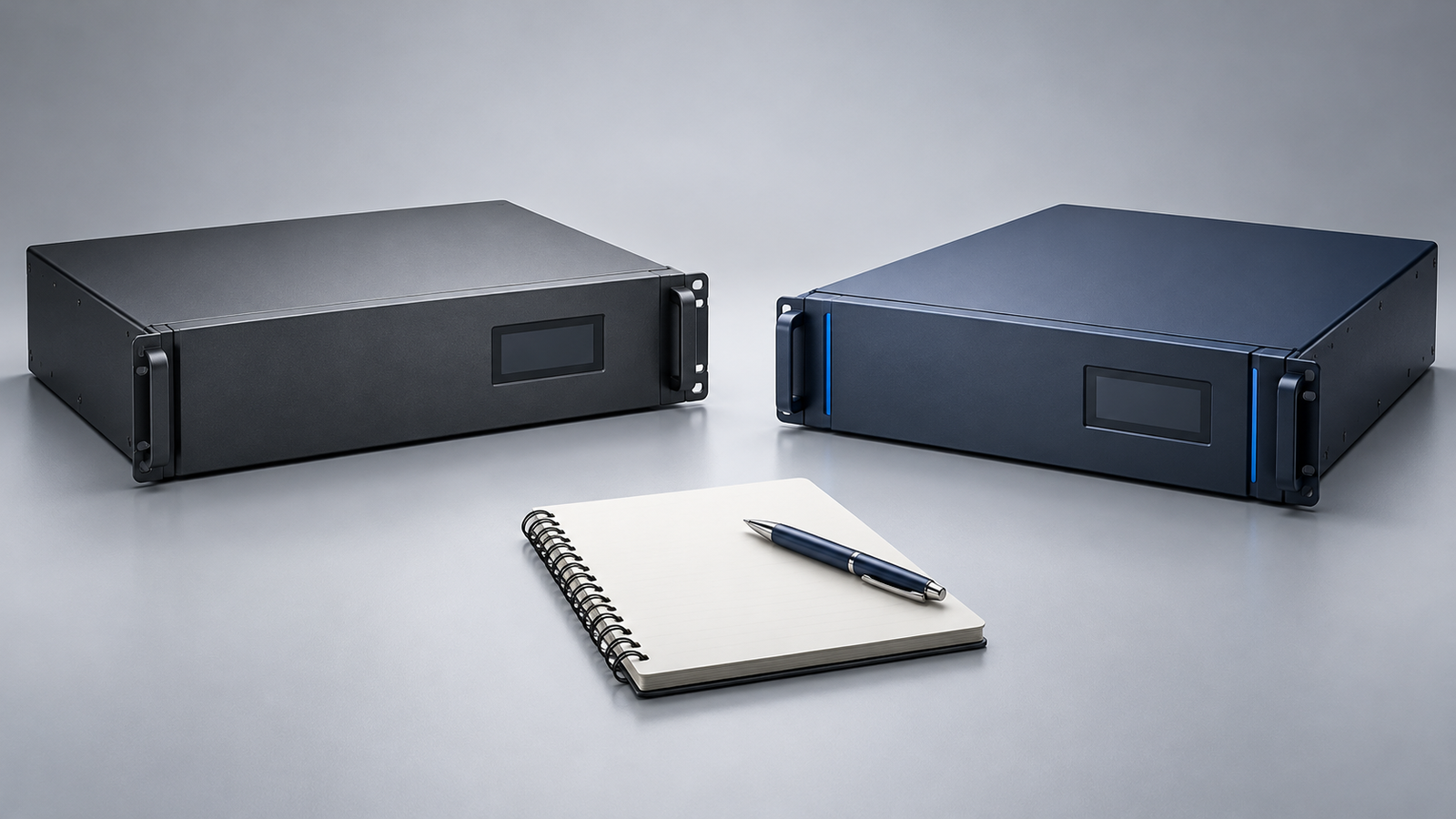
Similar voltage does not mean the same fit.
- Rack-format candidates
- Cubix100 and LPS48100-B list 5.12kWh nominal per unit.
- Smaller standalone alternative
- Renogy 48V 50Ah lists 2.4kWh nominal per unit; it is not a like-for-like rack battery.
- Compare separately
- Verify enclosure fit, current limits and documented inverter compatibility.
Editorial explanation, not a product photograph, performance test or installation design.
How we compared these batteries
We reviewed the brands’ current U.S. product pages and published specifications on September 30, 2026. The comparison focuses on stated nominal voltage, capacity, current limits, communication ports, product format, warranty information, operating conditions, and listed availability. We did not buy, install, cycle, open, or lab-test these units. Specifications, stock, prices, manuals, certifications, and warranty terms can change; confirm them on the current listing and manual for the exact model before ordering.
Comparison at a glance
| Option | Published capacity | Format and features | Best comparison use | Important caveat |
|---|---|---|---|---|
| ECO-WORTHY Cubix100 | 51.2V class, 100Ah, 5.12kWh | Server-rack battery; Bluetooth/Wi-Fi; CAN/RS485 listed | Compare when you need a 100Ah rack module and the product is available | Availability could not be confirmed on Oct. 11, 2026: the U.S. page showed conflicting “Sold out” and purchase-control signals; verify the 1 Pack option, ZIP-code delivery, and exact warranty/certification documents |
| VEVOR LPS48100-B | 51.2V, 100Ah, 5.12kWh | Server-rack listing; LCD/app; CAN/RS485 listed | Compare a 100Ah rack-format option with monitoring features | VEVOR says model LPS48100-B is not BMS-protocol compatible with LPS-48100; don’t infer inverter compatibility from a port alone |
| Renogy 48V 50Ah Smart LiFePO4 | 48V, 50Ah, 2.4kWh | Smaller standalone battery; self-heating; parallel expansion listed | Compare a smaller capacity or a different enclosure format | Not a like-for-like 100Ah server-rack battery; confirm current product dimensions and supported system |
1. ECO-WORTHY Cubix100: 100Ah rack option, currently check availability
ECO-WORTHY markets Cubix100 as a 48V/51.2V-class, 100Ah LiFePO4 server-rack battery with 5.12kWh listed energy. Its product page lists Bluetooth and Wi-Fi monitoring, CAN and RS485, a 100A maximum charge/discharge rate, and a 10-year limited warranty. The page also lists a 40–58V operating range and identifies certifications including UL 1973 and UL 9540A; read the current product documentation to confirm the scope and applicability of each claim. On October 11, 2026, the official U.S. listing showed conflicting “Sold out” and purchase-control signals, so availability of the standard Cubix100 1 Pack could not be confirmed. This storefront snapshot is not a delivery guarantee. Confirm the current version, stock, and shipping eligibility before ordering.
Potential fit: a buyer looking for a 5.12kWh rack module with monitoring and communications, provided the exact unit is in stock and its installation arrangement and system compatibility are documented. Before buying: check the current manual, cabinet dimensions, included hardware, warranty terms, listed certifications, and written compatibility with the exact inverter model. The product page is not a substitute for a complete system compatibility list.
Version check: This comparison refers to the standard Cubix100, not Cubix100 Pro V2. Do not transfer low-temperature charging features between versions. See our Cubix100 version checks before ordering.
Check the exact product: View ECO-WORTHY Cubix100 availability and current price. This is an affiliate link to the Cubix100 listing, not the brand homepage. Read our research-based Cubix100 review for the limitations and questions to ask before buying.
2. VEVOR LPS48100-B: 100Ah rack-format comparison
VEVOR lists model LPS48100-B as a 51.2V, 100Ah LiFePO4 battery with 5,120Wh capacity, a built-in BMS, a 100A maximum charge/discharge rating, LCD/app monitoring, and CAN/RS485 communications. The product listing describes it as a server-rack battery and states more than 6,000 cycles under its stated conditions. Cycle-life figures depend on test conditions such as depth of discharge, temperature, and end-of-life definition; compare the full manual rather than treating the number as a universal lifespan guarantee.
Critical model distinction: VEVOR’s product Q&A states that LPS48100-B is not compatible in BMS communication/protocol with LPS-48100. Similar names, voltage, or connectors do not prove a match. Ask the battery and inverter manufacturers to confirm the exact model, firmware, communication profile, and supported configuration in writing. Do not assume all VEVOR 48V batteries are interchangeable.
Potential fit: someone comparing a 5.12kWh rack-format module with built-in monitoring who can verify the cabinet fit and exact system documentation. Before buying: confirm the model number on the checkout page, dimensions and rack height, current limits, supported parallel arrangement, included communications cable, warranty, and certification documents. We do not confirm a 19-inch/3U fit unless the current official model drawing says so.
Check VEVOR’s U.S. listing: This tracked CJ affiliate link goes to the exact LPS48100-B product listing.
View VEVOR LPS48100-B on VEVOR U.S.Confirm current availability, delivery to your ZIP code, the exact model revision, and compatibility before ordering.
3. Renogy 48V 50Ah: a smaller, non-rack alternative
Renogy’s 48V 50Ah Smart LiFePO4 battery is a 2.4kWh-class product with self-heating and parallel expansion described on its current U.S. product page. The page lists a 50A maximum continuous charge/discharge current, IP65 enclosure rating, and a five-year prorated warranty. It is not a direct substitute for a 100Ah server-rack module: it has about half the nominal energy and a different enclosure/use case. It belongs in the comparison when a smaller capacity or its published features better match the buyer’s requirements—not because it is a rack battery.
Communication limitation: Renogy’s current specification table lists no built-in Bluetooth and no communication port for this model. Do not shortlist it for a system that requires closed-loop battery-to-inverter communication without written manufacturer confirmation of a supported arrangement.
Check this smaller alternative: View Renogy 48V 50Ah battery availability and current price. This is an affiliate link to the exact U.S. product listing. On October 11, 2026, the U.S. page marked the selected 1 Pack as backordered; confirm current fulfillment, shipping, and the supported system before buying.
Which one should you shortlist?
- For a 100Ah rack-format candidate: compare ECO-WORTHY Cubix100 and VEVOR LPS48100-B by current availability, exact cabinet fit, written inverter compatibility, warranty, support, and documentation. On October 11, 2026, ECO-WORTHY’s U.S. page showed conflicting availability signals, so stock for the 1 Pack could not be confirmed; verify the current variant and delivery address before committing to a purchase.
- For a smaller 48V-class battery: compare Renogy’s 50Ah model as a separate category. Confirm whether its physical format and supported expansion approach work for your planned setup.
- For cold-weather planning: compare the model’s actual charging and discharging limits and any low-temperature behavior. “Self-heating” or an operating temperature range does not automatically mean charging is permitted at every sub-freezing temperature.
- For communications-dependent systems: use the manufacturer’s compatibility list for the exact battery and inverter versions. CAN or RS485 availability alone is not proof of a working protocol match.
What matters more than a headline capacity
Usable energy and the way it is rated
A 5.12kWh nominal label does not tell you the usable energy for every application. Check the manufacturer’s permitted depth of discharge, reserve policy, inverter conversion losses, temperature limits, and warranty conditions. If you need multiple days of backup, estimate energy use first and use a sizing tool such as our solar battery calculator. Its result is an estimate, not an electrical design.
Continuous current, not just stored energy
Capacity in kWh and current capability answer different questions. Check the continuous charge and discharge limits in the manual and compare them with the equipment manufacturer’s requirements. Avoid sizing a system from a short-duration peak figure or multiplying a product’s maximum current without confirming the permitted battery configuration.
Rack and cabinet are separate decisions
“Server rack battery” describes a product format; it does not mean every rack, cabinet, rail, shelf, or battery is interchangeable. Verify unit height, depth, width, weight, ventilation and service clearances, mounting hardware, and the exact model’s installation manual. A rack or cabinet may be sold separately.
Warranty, support, and certification
Read the warranty itself: term, prorating, registration, cycle or throughput limits, installation requirements, exclusions, shipping responsibilities, and the process for a claim. If a product page names a safety standard or certification, look for the certificate or listing record and confirm it applies to the exact model. A marketing badge does not establish that a battery is approved for every use or jurisdiction.
A buyer’s checklist before ordering
- Write down the exact battery and inverter model numbers and confirm compatibility in official documentation.
- Compare nominal voltage, operating range, charge limits, and continuous current ratings.
- Check usable capacity, allowed depth of discharge, cycle-life test conditions, and reserve needs.
- Confirm BMS protocol, supported firmware, communication cables, and any required setup accessories.
- Measure the intended cabinet and verify dimensions, rack height, weight rating, ventilation, and service clearances.
- Review temperature behavior, especially low-temperature charging, using the exact model manual.
- Check the full warranty, certification documentation, shipping/return policy, and current stock.
- Use a qualified professional for installation, system protection, conductor sizing, and code compliance.
Frequently asked questions
Is there one best server-rack battery for every system?
No. Start with the exact system requirements, then compare the documented battery revision, physical fit, operating limits, support and total purchase requirements. This shortlist is research-based, not a laboratory ranking. A lower price or a larger nominal capacity does not resolve compatibility or installation suitability.
Why is the Renogy 48V 50Ah battery included if it is not a rack battery?
It is included as a different-format alternative, not a like-for-like rack winner. Renogy’s published specification table lists 48V, 50Ah and 2,400Wh for this model. Consider it separately if a smaller capacity and its documented enclosure suit your requirements. Do not assume it fits the same cabinet or supports the same communications arrangement as either rack candidate.
Does CAN or RS485 mean a battery works with my inverter?
No. A port name does not establish a supported protocol, firmware version or configuration. Check the exact battery and inverter combination in current manufacturer documentation and request written clarification when needed. VEVOR’s product Q&A specifically distinguishes the BMS communication/protocol of the newer B model from LPS-48100; similar names are not proof of interchangeability.
Can I compare the options only by their advertised kWh?
Nominal energy is a useful starting point, not a complete decision. Compare usable-energy definitions, operating limits, physical format, warranty terms and the equipment required for the intended system. Capacity does not tell you continuous power, delivered AC energy or runtime for an unspecified load. Keep battery-only pricing separate from cabinet and system costs.
Are the illustrations photographs of ECO-WORTHY, VEVOR or Renogy products?
No. The editorial illustrations explain selection concepts and are not exact product drawings, scale comparisons, installation diagrams or evidence of hands-on testing. Use each manufacturer’s current photographs, dimensions and manual to identify the product you would receive.
Does this comparison guarantee current stock or delivery to my U.S. address?
No. On October 11, 2026, the official U.S. pages showed VEVOR as in stock, ECO-WORTHY with conflicting availability signals, and Renogy’s selected 1 Pack as backordered. These are storefront snapshots, not delivery guarantees, and can change. Confirm the exact variant, delivery eligibility, included items, shipping charges and return terms on the current listing and checkout before ordering.
Continue your battery research
- Server-rack battery buying checklist — gather the documents and selection requirements before narrowing the shortlist.
- 48V battery format guide — distinguish rack, wall-mount and standalone formats.
- Battery rack and cabinet fit guide — investigate enclosure fit and accessories separately from the battery module.
Verdict
For shoppers specifically comparing 100Ah server-rack batteries, ECO-WORTHY Cubix100 and VEVOR LPS48100-B are the closer format-and-capacity comparison in this short list. Availability and documented system fit should decide the next step—not an unverified claim that one battery works with a particular inverter. Renogy’s 48V 50Ah unit is worth comparing when a smaller, different-format battery is appropriate, but it should not be ranked as a like-for-like rack module. If neither manufacturer’s current documentation answers a compatibility question, ask for written confirmation before purchasing.
Safety note: This guide supports product selection only. It is not electrical, engineering, or code advice. Battery systems can involve hazardous current and stored energy; have system design and installation reviewed by a qualified professional and follow manufacturer documentation and applicable local requirements.
Specifications checked: September 30, 2026. Availability rechecked: October 11, 2026 on the official U.S. pages for VEVOR, ECO-WORTHY, and Renogy; the status observations are summarized above. Affiliate destinations were last checked October 2, 2026. Prices, stock, product versions, specifications, warranty terms, and certifications can change. Verify the current official listing and manual before purchase.
Manufacturer references: ECO-WORTHY Cubix100 product page; VEVOR LPS48100-B product page; Renogy 48V 50Ah product page.