
Affiliate disclosure: SolOffGrid may earn a commission from qualifying purchases made through links on this page, at no additional cost to you. This guide is based on published manufacturer and rack specifications; we have not installed or physically tested the products discussed.
A solar battery rack or cabinet is the enclosure that holds and organizes compatible battery modules; it is not the battery itself. Before comparing a server-rack battery cabinet or its price, identify the exact battery dimensions, weight, mounting method, service clearances, and environmental requirements. A cabinet that looks like a standard server rack may still be a poor fit for a particular battery or location.
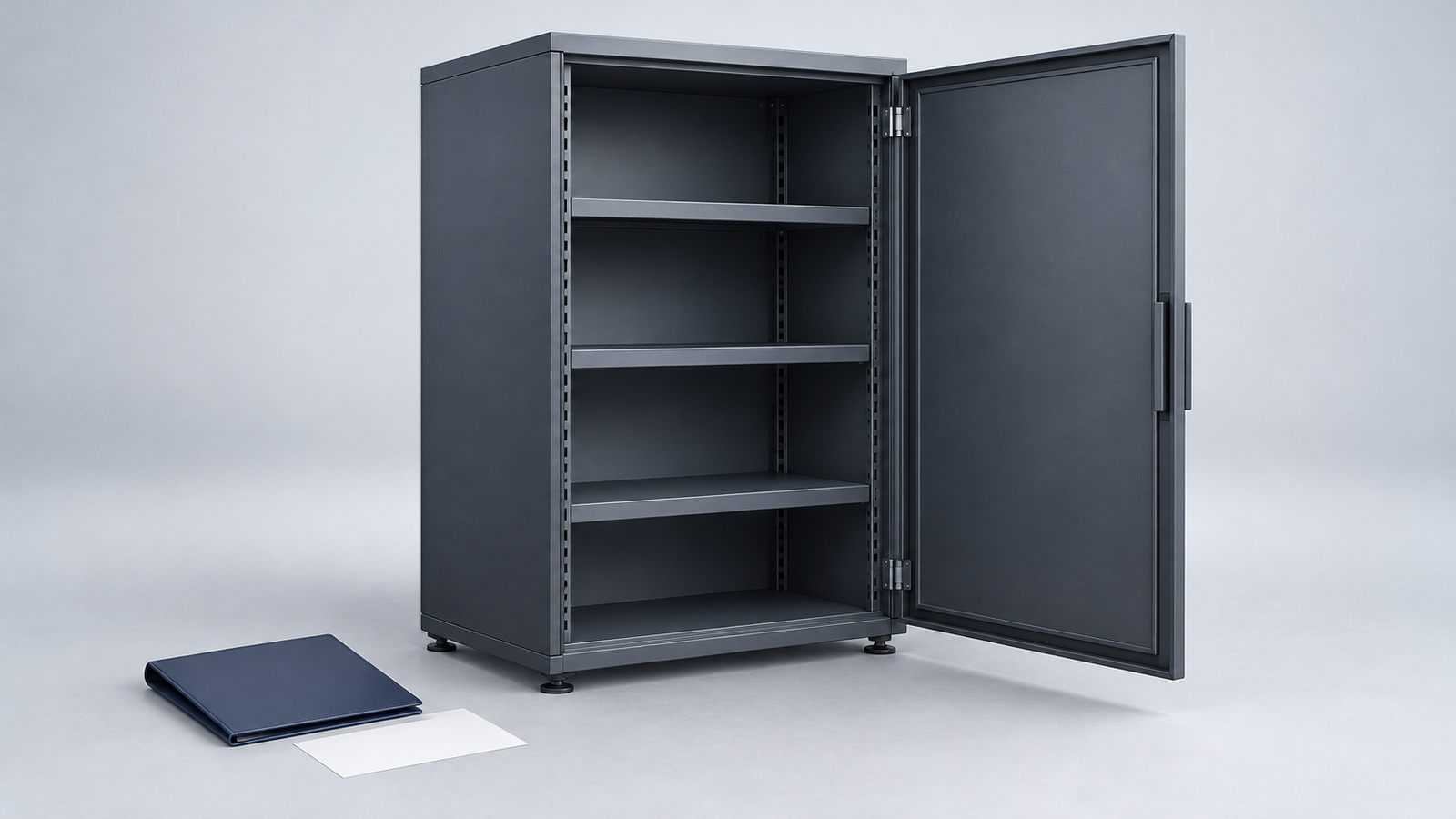
Will the battery fit—and remain serviceable?
- Dimensions and mounting
- Use exact battery and cabinet drawings to verify width, height, depth, rails and brackets.
- Support and load ratings
- Verify per-shelf and total load ratings, floor support and the approved mounting arrangement.
- Access and environment
- Verify cable space, door swing, service access, ventilation and approved location.
Editorial explanation, not a product photograph, performance test or installation design.
Battery vs. rack vs. cabinet
These terms are often used loosely in listings, so check what the purchase actually includes:
- Battery module: Stores energy and contains a battery-management system (BMS). A battery may be sold alone.
- Open rack: A frame with shelves or rails. It may have little protection from dust, impacts, or accidental contact and may not provide controlled environmental conditions.
- Enclosed cabinet: A cabinet with panels, doors, and sometimes cable-management or accessory provisions. These features vary; an enclosure is not automatically fire-rated or suitable for every indoor or outdoor location.
- Complete storage system: May include batteries, rack/cabinet, inverter, communications hardware, protection equipment, and other components. Only treat it as a complete package if the supplier clearly lists the included items and documented configuration.
What to measure before choosing a solar battery rack
Module width, height, and depth
Use the manufacturer’s drawing for the exact model, not a generic “19-inch rack battery” phrase. Check the external width, height, depth, front clearance, rear connections, cable bend space, handles, rails, and any mounting brackets. Rack-unit height is a measurement convention; it does not guarantee that rails, shelves, or mounting points align with a battery. Confirm the cabinet’s usable internal dimensions and the supplier’s approved mounting arrangement.
Weight and floor or wall support
Battery modules can be heavy, and a multi-module rack can concentrate substantial load in a small footprint. Compare the installed weight with the rack’s rated capacity and with the floor, platform, or wall support. Check how the rack load rating is specified—static, evenly distributed, or per shelf—and use the manufacturer’s mounting instructions. Do not assume a cabinet intended for IT equipment is automatically suitable for battery storage.
Service access and ventilation
Leave the access and clearances required by the battery, inverter, and enclosure manuals. Consider whether a technician can reach disconnects, connectors, displays, and service panels without moving heavy equipment. Some batteries need particular ambient-temperature conditions or airflow; an enclosed cabinet can change heat behavior. Follow the exact product documentation rather than adding fans or modifying an enclosure based on guesswork.
Location and environmental rating
Indoor, garage, utility-room, and outdoor placements have different exposure to moisture, dust, heat, cold, and impact. Check the enclosure’s documented environmental rating and whether the battery itself is approved for the planned location. A cabinet does not upgrade the battery’s own rating. If a setup will be outdoors, verify the full system’s temperature, ingress-protection, and installation requirements with the manufacturer and a qualified professional.
How much does a solar battery rack cost?
There is no reliable universal price for a solar battery rack. Cost depends on whether you are buying an open frame or enclosed cabinet, the materials and rated load, usable dimensions, included rails or shelves, cable-management features, shipping, and whether the seller bundles batteries or accessories. Prices and availability change, so compare current quotes and the exact bill of materials rather than relying on a price copied from an old article.
When comparing the cost of a server rack battery cabinet, ask for an itemized quote that separates the enclosure, battery modules, mounting hardware, communications accessories, shipping, and professional installation. Verify that the quote is for the same number and model of batteries and that each module is supported by the rack manufacturer. A low cabinet price is not a good value if the system later needs different rails, a stronger floor, or a different enclosure.
Compatibility includes more than physical fit
A battery may fit on a shelf yet still be unsuitable for the intended system. Electrical design and BMS communications are separate from rack dimensions. Confirm the exact battery and inverter model, supported battery count, voltage range, current limits, communication protocol, firmware requirements, and manufacturer-approved wiring/accessory arrangement in official documents. CAN and RS485 labels identify communication interfaces; they do not guarantee that two products use a compatible protocol.
For example, VEVOR distinguishes its LPS48100-B from the similarly named LPS-48100 and states their BMS communication protocols are not compatible. That is why the full product code and written compatibility information matter more than matching brand names or connector shapes. Do not combine modules or configure a bank unless the battery manufacturer allows that exact arrangement.
Open rack or enclosed cabinet?
| Consideration | Open rack | Enclosed cabinet |
|---|---|---|
| Access | Often straightforward access to modules and connections | Doors/panels may protect and organize equipment, but access depends on design |
| Environmental protection | Usually limited; verify actual design | May provide some enclosure, but don’t assume a particular ingress or fire rating |
| Space and fit | Check frame dimensions, rail spacing, load, and cable clearance | Check usable internal dimensions, door swing, rails, airflow, and service clearance |
| Cost | Can vary widely with load rating and included rails | Can vary with materials, enclosure features, and system integration |
| Best next step | Match the exact battery manual and rated shelf/frame details | Confirm the battery and cabinet are approved for the planned location and use |
Questions to ask a rack or battery supplier
- What exact battery models and revisions are supported in this rack or cabinet?
- What are the usable internal dimensions, per-shelf rating, total load rating, and mounting method?
- Are rails, shelves, brackets, cable guides, and communications cables included?
- What service, ventilation, and temperature clearances does the manufacturer require?
- Is the enclosure suitable for the intended indoor or outdoor location, and what documentation supports that claim?
- Does the cabinet change the battery’s warranty or installation requirements?
- Can the battery and inverter manufacturers confirm the exact system configuration in writing?
A practical selection sequence
Start with the battery model and its official manual. Record the dimensions, mass, clearances, temperature range, supported orientation, and service access. Then identify the manufacturer’s approved rack/cabinet requirements and check the room, floor, doorway, and access route. After the physical fit is established, verify system compatibility and obtain an itemized current quote. This order helps prevent choosing an attractive cabinet that cannot safely support or accommodate the planned equipment.
For a broader comparison of the batteries themselves, see our server rack battery guide and 48V solar battery guide. Use the solar battery calculator to get a preliminary capacity estimate; the tool does not size a rack, specify conductors, or replace a system design.
Frequently asked questions
Is a battery cabinet the same as a complete storage system?
No. A cabinet is an enclosure; the purchase may not include batteries, an inverter, protective equipment or communication accessories. Ask for an itemized list of included parts and the documented configuration. Do not infer a complete, approved system from a cabinet photograph or product title.
Will any server-rack battery fit an ordinary server cabinet?
Do not assume that. Compare exact-model drawings, usable internal dimensions, mounting hardware, supported orientation and service access. Check both per-shelf and total load ratings. Matching a rack description alone does not establish a supported battery-and-cabinet combination.
Is the cabinet’s total load rating enough to choose the shelves?
No. Review the documented per-shelf support, total rated load and approved mounting arrangement together with the planned equipment weight. A total cabinet rating does not identify how much weight each shelf or rail can support. Floor and mounting suitability require separate review by a qualified professional.
Does an enclosed cabinet make an indoor battery suitable outdoors?
Do not assume it does. Verify the cabinet’s documented environmental protection and the battery’s own location and operating restrictions. The enclosure does not automatically upgrade the battery’s rating. Ask the manufacturers to confirm the intended arrangement and location before selecting equipment.
How much space should I leave around a battery cabinet?
There is no universal clearance specified by this guide. Obtain the requirements for the exact battery, cabinet and associated equipment. Include door movement, connection access, service access and documented ventilation needs in the review. The illustration is not to scale and provides no installation distances.
What should a rack or cabinet quote include?
Request separate line items for the enclosure, battery modules, supported shelves or rails, brackets, communication accessories, shipping and professional installation. Confirm the exact model and quantity of each item. Compare current quotes for equivalent documented configurations rather than a cabinet-only headline price.
Continue your battery and cabinet research
- Compare the documented 48V-class battery options — identify candidate modules before assuming cabinet compatibility.
- Read the ECO-WORTHY Cubix100 research-based review — organize the model-specific checks for one candidate.
- Read the VEVOR LPS48100-B research-based review — distinguish the exact revision and its documentation from similarly named products.
Bottom line
Choose a solar battery rack or cabinet by exact product dimensions, rated support, access, environmental requirements, and written compatibility—not by the word “standard” in a product title. Battery, cabinet, and complete storage system are different purchases. Confirm what is included, compare current itemized pricing, and have a qualified professional review system design and installation.
Safety note: This is product-selection guidance, not electrical, engineering, or code advice. Battery systems contain stored energy and can involve hazardous currents. Follow current manufacturer documentation and local requirements, and use a qualified professional for system design and installation.
Updated: September 30, 2026. Product availability, prices, dimensions, rack ratings, and installation requirements can change. Confirm the exact current product manuals and specifications before purchase.