
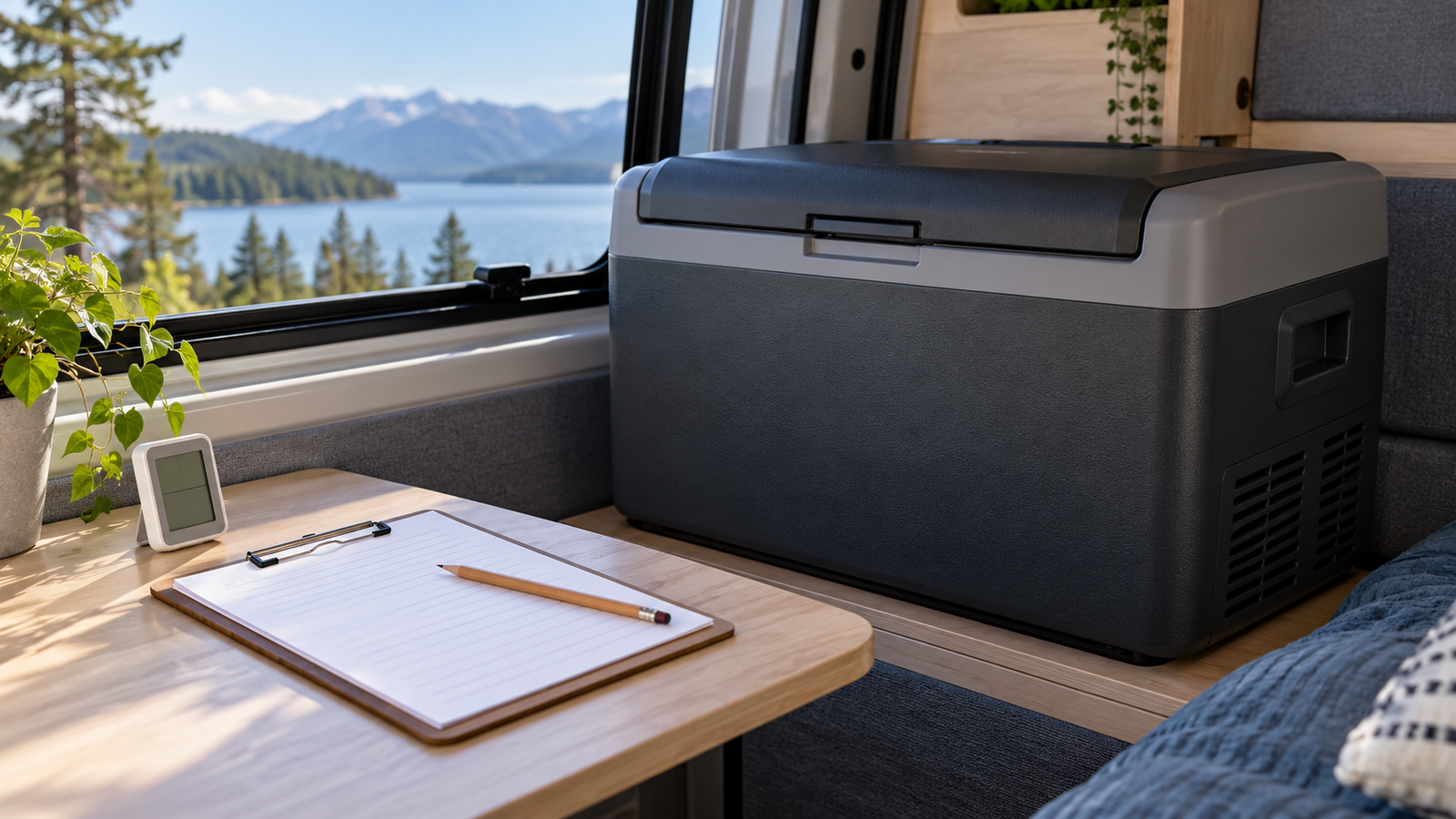
A fridge’s wattage label does not tell you how much battery energy it will use overnight. A compressor can cycle on and off, and your temperature settings, surroundings and starting conditions affect the result. To plan a trip, you need energy over time, not just the watts shown at one moment.
This guide explains how to record that energy, identify what your measurement includes and turn the result into a daily budget. It is a measurement worksheet, not a hands-on fridge review. SolOffGrid has not physically tested the refrigerators discussed in our related guides. All numerical examples below are hypothetical.
Quick answer: measure watt-hours over a representative period
Record the energy used during a known period, ideally covering both daytime and nighttime conditions. A 24- or 48-hour record can be useful, but it is only representative of the conditions you recorded—not every future trip.
If your meter records kilowatt-hours, use:
Daily energy estimate (Wh/day) = recorded kWh × 1,000 × 24 ÷ elapsed hours.
For example, an illustrative reading of 0.64 kWh over 48 hours equals 640 Wh over two days, or 320 Wh/day. It does not establish that a particular fridge uses 320 Wh/day.
Before choosing equipment, see our dual-zone fridge controls and size checklist. For battery selection, use the separate built-in fridge battery versus portable power station guide.
Watts, watt-hours and amp-hours are different
| Reading | What it describes | What it cannot tell you alone |
|---|---|---|
| W: watts | Power at a moment, or a rated input specified by the manufacturer | Energy needed for a full day |
| Wh: watt-hours | Energy accumulated over a period | Whether the period represents hotter weather or another setup |
| kWh: kilowatt-hours | Energy in larger units; 1 kWh equals 1,000 Wh | Direct DC consumption if measured at an AC adapter’s input |
| A: amps | Current at the measurement point | Daily energy without voltage and time information |
| Ah: amp-hours | Accumulated electric charge | Comparable energy between batteries with different voltages |
Do not multiply a fridge’s rated watts by 24 and present the answer as its measured daily consumption. That calculation assumes the rated power applies continuously. It can be a rough scenario, but it is not a compressor-cycle measurement.
Likewise, a power station showing 45 W for a few seconds does not establish a 45 W daily average. The compressor may stop later, and a display may round small loads or include other equipment.
Choose your measurement point before choosing a meter
The measurement point determines what your number means. Keep it written beside every result.
| Measurement method | What the result includes | Important limitation |
|---|---|---|
| Compatible plug-in AC energy meter, with the fridge’s approved AC adapter | Energy entering that adapter, including its conversion losses | Not the same as energy entering the fridge directly through a 12V cable |
| Properly rated DC energy logger compatible with the manufacturer’s supplied connections | Energy passing through that DC measurement point | Logger, connectors, voltage and current ratings must suit the exact setup |
| Power station battery-percentage change | A rough indication of depletion for the whole connected setup | Not a calibrated fridge-only Wh measurement; rounding, other loads and operating modes matter |
A household AC meter is not a 12V DC meter. For example, P3’s official P4400 Kill A Watt specifications identify a 115V AC device with maximum ratings of 125V AC, 15 A and 1,875 VA. Do not insert that device into a vehicle’s 12V outlet or modify it for DC use. See the official P4400 specifications and manufacturer’s manual.
For an AC measurement, use only equipment compatible with your supply and the fridge’s approved adapter, following both manuals and all ratings. For direct DC logging, use a manufacturer-approved, appropriately rated solution with compatible connections. This guide does not provide instructions for cutting cables, installing shunts or modifying vehicle wiring. If suitable plug-in equipment is unavailable, get qualified help rather than improvising a connection.
A practical consumption-recording procedure
1. Describe the setup
Record the exact fridge model, the power route and where energy will be measured. Specify whether you are running one compartment or two, the temperature settings and the operating mode.
Follow the manufacturer’s ventilation and placement requirements. Do not cover compressor vents with insulation, towels or reflective blankets. A cooler location is not a reason to obstruct airflow.
2. Separate initial cooling from temperature maintenance
A warm fridge loaded with warm contents is a different starting condition from a pre-cooled fridge maintaining temperature. Record which one you are measuring.
If your trip begins with a warm fridge, its initial cooling energy belongs in that trip’s budget. If you pre-cool from household power before departure, you can record that phase separately from the battery-powered phase. Do not silently remove it from a result described as total energy.
3. Record starting energy and elapsed time
Write down the meter reading and the start time. You do not need to reset a cumulative meter if you can subtract the starting reading from the ending reading and accurately track elapsed time.
The P4400 manual describes accumulated kWh and elapsed-time readings. It also explains that its counters reset when power is removed. Record readings before a planned reset or power interruption, and flag any interrupted run rather than treating missing time as zero consumption.
4. Run a representative period
Keep ordinary usage conditions documented: ambient temperature range, lid openings, contents and settings. Do not change multiple variables and then attribute the difference to only one of them.
Avoid a very short reading taken only during compressor operation. A longer record can capture cycling and changing conditions, but it still needs to resemble the use you are planning. Repeat the record under relevant conditions if practical; a mild indoor day does not establish a hot vehicle’s energy requirement.
5. Subtract readings and calculate
Subtract starting kWh from ending kWh. Convert the difference to Wh, then divide by the elapsed hours to find average power. Normalize to a day only if that is a sensible representation of the measured period.
If two days have different conditions, retain the individual daily readings as well as the combined average. Averages can hide the more demanding day.
Worked example: converting a meter reading
Illustrative only: these figures are not a SolOffGrid product test. Assume a compatible AC meter measures a fridge through its approved adapter. The starting reading is 1.20 kWh, and the ending reading after exactly 48 hours is 1.84 kWh.
| Calculation | Result | Meaning |
|---|---|---|
| 1.84 − 1.20 kWh | 0.64 kWh | Energy entering the adapter during the recorded period |
| 0.64 × 1,000 | 640 Wh | Same energy in watt-hours |
| 640 ÷ 48 hours | About 13.3 W | Average power across that period, not peak input |
| 640 × 24 ÷ 48 hours | 320 Wh/day | Daily estimate for those recorded conditions |
This reading includes the AC adapter’s losses. It does not include an upstream power station inverter’s own energy use, and it does not establish direct-DC consumption. If you change the power route, do not assume the number transfers unchanged.
Copyable measurement log
Use one entry per recording period. The blank fields are intentional: fill them with your own observations, not advertised runtime figures.
| Item | Your record |
|---|---|
| Date and exact fridge model | __________ |
| Power route and measurement point | __________ |
| Meter model and applicable ratings | __________ |
| Compartment settings and operating mode | __________ |
| Ambient temperature range | __________ |
| Initial cooling included, excluded or recorded separately | __________ |
| Contents, lid openings and placement notes | __________ |
| Starting reading and time | __________ |
| Ending reading and time | __________ |
| Energy difference and elapsed hours | __________ |
| Wh/day estimate, if representative | __________ |
| Interruptions, resets, recharging or other loads | __________ |
For comparisons, keep the settings and method consistent. Two fridges measured in different conditions are not a controlled efficiency comparison.
Turn the record into a trip budget
Start with your recorded daily fridge energy and multiply it by the planned number of days. Add separately recorded initial cooling if applicable, other loads and a planning reserve appropriate to your conditions.
Do not equate a power station’s nominal battery capacity with guaranteed energy delivered to the fridge. The output route, operating settings, conversion losses and reserve affect the usable budget. Conversely, do not add the same loss twice: adapter losses already included in an AC-input measurement do not need to be added again at that same point.
Treat solar charging separately. A sunny-day result with recharging is not a no-recharge battery-runtime test. Keep charging and consumption records distinct unless your measurement system can account for both accurately.
Use the fridge battery guide for the next decision: an optional fridge battery or a compatible portable power station. A consumption record improves that decision, but it does not replace checking the exact manufacturer’s output requirements.
Energy planning is only one part of choosing an appliance. Use our compact 12V refrigerator fit checklist to check external dimensions, lid access and manufacturer-required ventilation space before ordering.
Frequently asked questions
How much power does a 12V fridge use per day?
There is no single reliable number for all models and conditions. Measure accumulated energy for your setup over a representative period, and record temperature settings, surroundings and starting conditions. Manufacturer figures are useful only within their stated conditions.
Can I use a Kill A Watt to measure a 12V fridge?
A compatible AC meter can measure energy entering the fridge’s approved AC adapter on a suitable AC supply. The P4400 is an AC device, not a direct 12V DC logger. Its result includes adapter losses and must not be labeled direct-DC consumption.
Is the wattage on the fridge label its daily average?
No. Rated input and average power over a day are different quantities. Daily energy depends on what happens throughout the recording period, including compressor cycling.
Can I calculate consumption from battery percentage?
You can use the percentage change as a rough indication, but it is not a calibrated fridge-only energy measurement. Other loads, display rounding and the power station’s behavior can affect it. Label percentage-based calculations as estimates.
Is a 48-hour reading enough to size a battery?
It can provide a useful starting point if the conditions resemble your trip. It does not cover every weather pattern or operating mode. Retain the conditions, account for other loads and reserve, and avoid promising a fixed runtime from one record.
Sources and scope
- P3 International P4400 manual: accumulated kWh, elapsed time, counter resets and rating precautions.
- P3 International P4400 specifications: AC voltage and maximum device ratings.
This is an educational measurement guide, not a wiring tutorial, food-temperature certification or guarantee of runtime. Follow your equipment manuals and applicable safety requirements. Numerical examples are hypothetical; the worksheet contains no claimed product-test results.