
Affiliate disclosure: SolOffGrid may earn a commission from qualifying purchases made through links on this page, at no additional cost to you. Product details below are research-based; we have not physically tested these batteries.
A server-rack battery is a lithium battery packaged in a rack-mount enclosure for a stationary energy-storage system. For off-grid solar and home backup, the label “48V” often refers to a 51.2V nominal LiFePO₄ battery. The right choice depends less on the rack label than on usable energy, documented inverter compatibility, protection limits, communications, space, warranty and local availability.
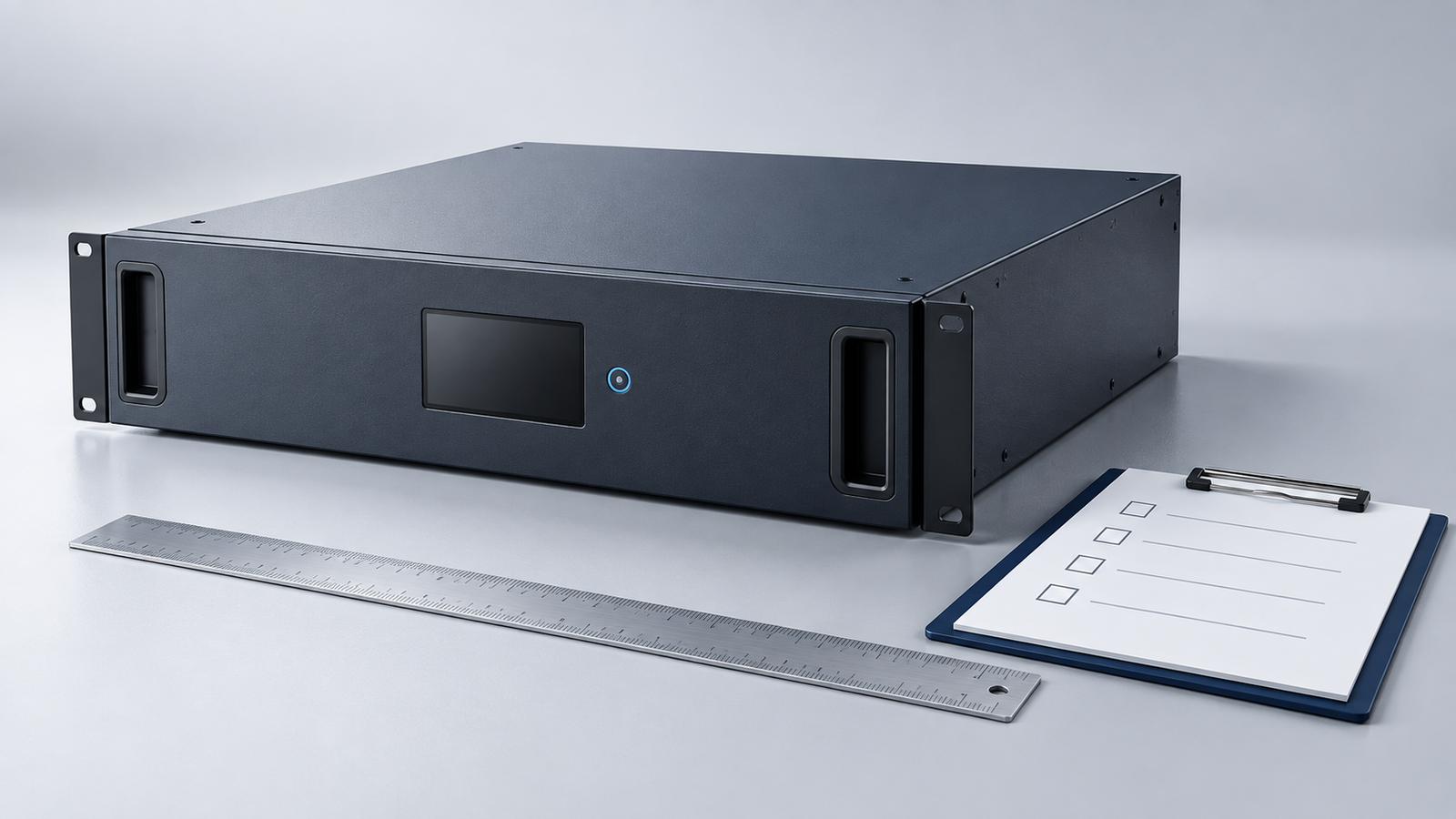
A rack format is not a complete system.
- Energy
- Nominal capacity is not usable energy. Check usable capacity, reserve and operating limits.
- Physical fit
- Verify battery and cabinet dimensions, rated support and service access.
- Compatibility
- Verify exact battery and inverter models, firmware and protocol documentation.
Editorial explanation, not a product photograph, performance test or installation design.
What “48V server-rack battery” means
LiFePO₄ cells are commonly rated around 3.2V nominal. A 16-cell series battery is therefore 51.2V nominal, while sellers may market the product for a “48V system.” Treat the model’s actual voltage range and charging limits—not the shorthand in its name—as the numbers to compare. For example, 51.2V × 100Ah equals 5,120Wh, or 5.12kWh of nominal energy. The amount available to loads is lower and depends on the manufacturer’s allowed depth of discharge, inverter losses, reserve settings and operating conditions.
Check these specifications before comparing prices
- Nominal voltage and operating range: Compare the battery’s published charge/discharge range with the exact inverter or charger documentation.
- Capacity and usable energy: Convert volts × amp-hours to nominal watt-hours, then check the manufacturer’s usable-capacity guidance. Do not assume every advertised kWh is available continuously.
- Continuous current and power: A 100Ah label alone does not tell you the maximum continuous load. Check the BMS current limits and product manual.
- Form factor: Confirm the exact width, depth, height, weight, terminal orientation and rack/cabinet requirements. “Rack mount” does not guarantee that every model fits every cabinet.
- BMS and communications: CAN, RS-485 or Bluetooth features are useful only when the specific inverter and battery models document compatible protocols and settings.
- Temperature limits: Check separate charging, discharging and storage ranges. Low-temperature charging restrictions matter in unheated spaces.
- Certifications and warranty: Verify the certificate applies to the exact battery model and intended system; do not infer that a certification of one product covers an entire installation.
Before you buy: a document checklist
A rack-format enclosure is only one part of the decision. Gather the documents below for the exact battery revision and your proposed system before ordering. A missing answer is a reason to ask the supplier—not to assume compatibility.
| Decision | What to collect | What not to assume |
|---|---|---|
| Energy budget | Your daily energy use, reserve target, and the battery’s documented usable-capacity limits | Advertised nominal kWh equals energy delivered to appliances |
| Power limits | Continuous charge/discharge limits from the battery manual and requirements of the inverter | An Ah rating establishes how much continuous power the system can deliver |
| Inverter pairing | Exact model names, supported firmware, charge settings and documented communication method | Matching voltage labels or CAN/RS485 connectors establish compatibility |
| Physical fit | Battery dimensions and weight, cabinet support rating, mounting details and service-access requirements | Every rack-format battery fits every cabinet |
| Installation location | Model-specific operating ranges and enclosure/location restrictions | A battery is suitable outdoors or for cold-weather charging because it is LiFePO4 |
| Purchase scope | Written list of included accessories, shipping terms, warranty and applicable model/system documentation | The battery price includes a cabinet, inverter or complete approved installation |
Server rack, wall-mount or standalone battery?
A rack battery may suit a fixed installation where several modules, service access and a compatible cabinet are planned together. A wall-mount battery can be a better fit where floor space or rack equipment is limited, but its enclosure and mounting requirements differ. A standalone battery may offer simpler placement, yet still needs a documented charging and inverter pairing. Compare the full system—not just battery price—including cabinet, disconnects, cables, monitoring hardware and any required listed equipment. Have a qualified installer confirm code and installation requirements.
How to size a battery bank
Start with daily energy use in watt-hours, the number of autonomy days you want, and the battery’s usable fraction. A planning estimate is: nominal battery energy (kWh) = daily use (kWh) × autonomy days ÷ usable fraction. This is an estimate, not an installation specification; conversion losses, reserve, temperature and peak loads can change the required capacity. Use the Battery Storage hub and the planned solar battery calculator as planning aids, then confirm product limits in manufacturer documentation.
What the current product examples do—and do not—tell you
Eco-Worthy lists a Cubix100 server-rack model in the 51.2V, 100Ah, 5.12kWh class. Check the current U.S. product page and manual for the exact revision, included accessories, certifications, warranty, price and stock before making a decision. Renogy’s 48V 50Ah Smart LiFePO₄ battery is a smaller 2.4kWh-class product and should not be called a server-rack battery unless the exact model documentation confirms that form factor. A VEVOR 51.2V/100Ah product may be a comparison candidate, but we will only recommend it after confirming the active U.S. listing, current specifications and a working tracked affiliate link.
Compatibility and safety limits
Do not assume two products work together because both are described as “48V.” Confirm the battery model, inverter model, firmware, charge profile, current limits and communication method in manufacturer documentation. This guide is for product selection, not wiring instructions. Battery banks can deliver hazardous current; installation, protection, conductor sizing, grounding and permitting should follow the product manuals and applicable local codes, with a qualified professional where appropriate.
Frequently asked questions
Is a server-rack battery a portable power station?
No. A rack-format battery is a storage component. A portable power station typically combines storage with power conversion and appliance outputs. Do not treat a standalone battery module as a ready-to-use AC power source; the required system equipment and installation depend on its documentation.
Does a 48V label mean the battery is exactly 48V nominal?
Not always. Check the specification sheet rather than the marketing label. For example, ECO-WORTHY lists the Cubix100 in the 48V class with a 51.2V nominal specification. Do not apply that number to every battery marketed as 48V.
How much nominal energy does a 51.2V 100Ah battery store?
The calculation is 51.2 × 100 = 5,120Wh, or 5.12kWh. That is nominal stored energy, not guaranteed energy at an AC outlet. Discharge limits, reserve, conversion losses and operating conditions affect the amount available to your loads.
Can any 48V inverter work with any 48V rack battery?
Do not assume that. Confirm the exact battery and inverter models, allowable voltage and current ranges, charge settings and any supported communication requirements in their documentation. A matching connector or voltage class is not sufficient evidence of a supported pairing.
Should I buy the cabinet before choosing the battery?
Choose them together. Compare the exact module dimensions and weight with the cabinet’s supported configuration and service-access requirements. Do not order based on a generic “rack mount” description alone. Ask the supplier to confirm the pairing when the documentation does not identify it clearly.
Continue your battery research
- Compare the documented 48V-class options after defining your requirements.
- Check battery rack and cabinet fit before planning the enclosure.
- Understand different 48V battery formats if rack, wall-mount and standalone options are still on your shortlist.
Our research method
We compare published manufacturer specifications, manuals, warranty terms, certification documents and current U.S. availability. We distinguish nominal from usable capacity and identify when products differ in size or intended use. We do not claim hands-on testing, independent certification verification or inverter compatibility unless the evidence is explicitly documented. Prices and stock can change; verify them with the manufacturer before purchase. Specifications checked: September 30, 2026.