
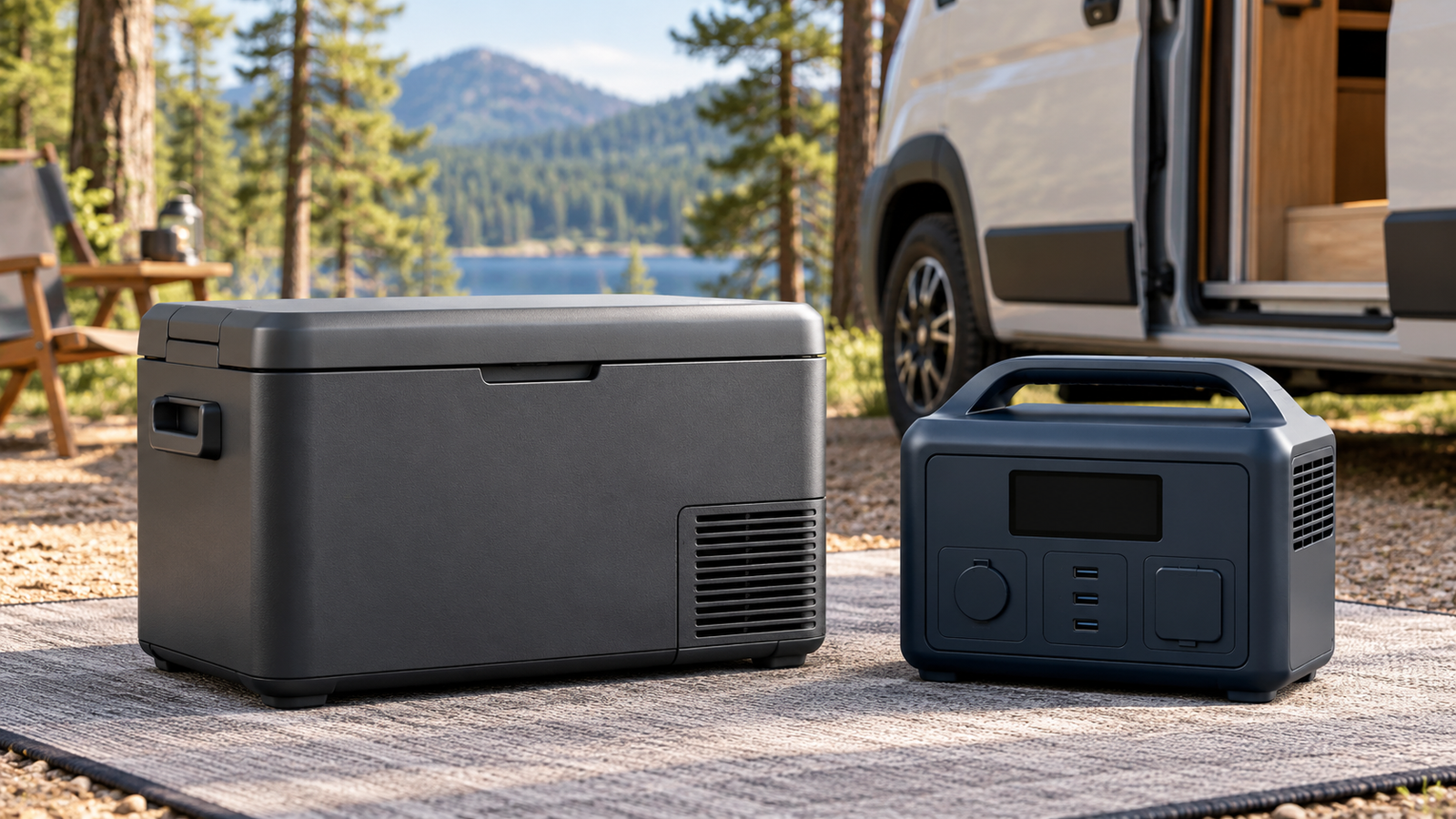
Choosing a 12V fridge battery starts with two separate questions: can the power source operate your exact fridge, and does it store enough usable energy for your trip? A battery that fits neatly into the fridge may be convenient. A portable power station can support a wider set of devices. Neither choice guarantees a particular runtime.
This guide focuses on portable 12V compressor refrigerators, not household refrigerators or a hardwired RV electrical installation. We compare documented features and explain a planning method; we have not physically tested these products or measured their daily energy consumption.
Quick answer: which power option fits your trip?
Consider a manufacturer-approved integrated or detachable pack when moving the fridge without a separate power box is your priority. Consider a portable power station when you also need to supply other devices or want to choose your energy capacity separately. In both cases, check compatibility, included accessories and a realistic energy budget before buying.
| Option | Why you might consider it | What you must verify |
|---|---|---|
| Fridge-specific battery pack | A compact package for moving the fridge between locations | Exact supported fridge model, included battery, charging method and usable energy |
| Portable power station | One external power source for the fridge and other compatible loads | Output voltage and current, connector, low-load settings and total energy needs |
| Installed auxiliary battery system | A permanent vehicle setup planned around several loads | Professional design, appropriate protection and the appliance’s installation requirements |
The third option is not a wiring tutorial. For an installed system, use qualified guidance and the relevant equipment instructions rather than improvising connections.
Built-in battery or external station: what changes?
The main difference is the package you carry and maintain. With a fridge-specific pack, confirm whether the battery is included, optional or sold separately. An empty battery compartment is not a battery bundle, and similar-looking packs are not proof of compatibility.
With an external station, allow space for both devices, their ventilation and the connecting cord. Include everything else you plan to power in the energy budget. Charging a phone from the same station reduces the energy available for the fridge; the station’s headline battery capacity is not dedicated entirely to refrigeration.
Before buying a second power source, inventory the compatible equipment you already own. A battery-inclusive fridge may be unnecessary if an existing station meets your requirements. Conversely, a low fridge-only price may leave you needing a separate battery, charging equipment or other accessories.
If you are still choosing the refrigerator itself, see our dual-zone fridge freezer buying checklist. That guide covers compartment controls and physical fit rather than duplicating the power decision here.
What must match before you connect the fridge?
Read the fridge’s required input and the power source’s supported output. Do not confuse a station’s charging input with its output to an appliance. A label saying “12V” on both products is not a complete compatibility check.
| Check | Why it matters |
|---|---|
| Voltage and permitted current | The chosen output must meet the appliance’s requirements within its limits |
| Connector and approved cord | Shape alone does not establish electrical compatibility |
| Starting and operating requirements | A capacity figure in watt-hours does not establish the output can operate the load |
| Output settings and protection | A power source can stop supplying power even when energy remains |
| AC adapter, if using AC | Use the fridge’s specified adapter and check the station’s AC output requirements |
We have not verified a particular fridge-and-station pairing through a physical test. Where documentation does not establish a requirement, ask the manufacturer rather than guessing or using an improvised adapter.
For the broader station-selection process, see how to choose a portable power station.
Can a power station shut off while a fridge is connected?
Check this before relying on it for a trip. The US manual for the Jackery Explorer 1000 v2, model JE-1000D, describes an Energy Saving Mode that can turn outputs off after 12 hours under its specified low-load conditions. Its table lists thresholds of 25W or less for AC and 2W or less for USB/car output. The manual also explains how the mode is disabled. Jackery US manual, Energy Saving Mode.
This does not mean every cycling refrigerator will trigger that shutdown. Check how your actual load behaves, the selected settings and the instructions for your unit. Do not confuse Energy Saving Mode with the separate Battery Saving Mode, which the manual says reduces available battery capacity.
A useful pre-trip check is to run the intended setup through representative fridge operating cycles and confirm the output remains available. That check does not prove a guaranteed food-storage duration or replace appliance safety guidance.
How much battery capacity do you need?
Use daily energy in watt-hours (Wh) rather than treating the compressor’s rated watts as a continuous 24-hour load. Your planning figure should represent the conditions you expect: ambient temperature, temperature settings, contents, lid opening and ventilation.
Record the measurement point. Energy measured at the fridge input excludes losses upstream of that point; a battery-side measurement may already include some of those losses. Applying the same loss allowance twice gives a misleading result.
Start with:
Required delivered energy = (fridge Wh per day + other loads Wh per day) × days without dependable recharging.
Then translate that delivered requirement into nominal battery capacity using explicitly stated assumptions about reserve, delivery losses and any relevant settings. If daily use is unknown, the calculation is a planning scenario, not a runtime prediction.
Worked example — hypothetical, not a product test
Assume a fridge needs 320Wh per day, other devices need 40Wh per day, and the trip requires two days without recharging. These are invented example inputs, not BougeRV or Jackery measurements.
| Step | Calculation | Result |
|---|---|---|
| Daily delivered energy | 320Wh + 40Wh | 360Wh/day |
| Two-day requirement | 360Wh/day × 2 days | 720Wh |
| Assumed usable fraction after reserve | Retain 20% reserve | 0.80 |
| Assumed delivery factor | Illustrative conversion/delivery allowance | 0.90 |
| Nominal capacity needed under these assumptions | 720Wh ÷ (0.80 × 0.90) | 1,000Wh |
Under the same assumptions, a hypothetical 600Wh battery would supply 432Wh to those loads, equivalent to about 1.2 days at the assumed 360Wh/day. Change the daily use or the delivery assumptions and the result changes.
The 0.90 factor is not a measured efficiency for any named device. The example does not establish that a particular 1,000Wh-class station will operate your fridge for two days. It also excludes replenishment from driving or solar; count those only when you have a defensible charging plan.
What do the documented BougeRV and Jackery examples show?
These examples illustrate two formats, not a tested head-to-head runtime comparison.
| Example | Documented detail | Purchasing implication |
|---|---|---|
| BougeRV CRD2 V2.0 43QT US battery bundle | Selected package includes a detachable 240Wh battery; a separate fridge-only option excludes it | Verify the selected package instead of assuming every fridge includes a pack |
| Jackery Explorer 1000 v2 US, JE-1000D | 1,070Wh nominal capacity and a 12V/10A car output are documented | Check output requirements and settings separately from nominal capacity |
BougeRV’s current US package listing and its linked CRD2 family manual distinguish the optional battery accessory and charging arrangements. We do not convert the advertised maximum runtime into a promise for your trip.
Jackery’s US Explorer 1000 v2 listing provides the station specifications. A larger nominal capacity does not by itself prove compatibility, uninterrupted operation or how much energy reaches the fridge. It is not a reason to buy that size if a smaller, properly documented setup meets your needs.
Compare the complete purchase: fridge, selected pack or station, required cords or adapters, delivery and return conditions. Confirm current US availability and the exact variant before paying.
Check BougeRV CRD2 V2.0 US packages
Affiliate link. Check whether your selected package includes the detachable battery.
Check Jackery Explorer 1000 v2 US specs
Affiliate link. Check the output requirements and settings for your fridge. This is not a tested pairing or a runtime guarantee.
What changes if you recharge with solar?
Solar adds a replenishment plan; it does not remove the need for battery capacity or electrical compatibility. Identify which device accepts the solar input and the required charging equipment. A refrigerator advertised for off-grid use is not automatically ready for any panel connected directly to it.
Check the charging input range, connector, approved accessories and operating instructions for the exact device. Plan for the actual location and conditions rather than assuming a fixed amount of daily solar energy everywhere.
For an initial no-recharge budget, leave solar out of the calculation. Add it later when the proposed charging setup and expected energy contribution have been established. This guide does not prescribe a universal panel wattage or guarantee daily replenishment.
Frequently asked questions
Will a 100Ah battery run a 12V fridge all weekend?
Not enough information. You need the battery’s nominal voltage, usable capacity, fridge energy use, other loads and trip length. For example, 100Ah at a stated 12.8V equals 1,280Wh nominally, not 1,280Wh guaranteed at the appliance. Follow that battery’s documentation for its usable limits.
Does a portable fridge with a battery slot include a battery?
Not necessarily. Confirm the selected bundle and contents. The BougeRV example above has distinct battery-inclusive and fridge-only options.
Can I use a USB power bank instead?
Do not treat USB and a fridge’s DC input as interchangeable. Use only a documented supported power arrangement; an adapter’s physical fit is not proof of suitable voltage, current or control behavior.
Can compressor cycling affect the power source?
Check the source’s low-load, standby and output-control behavior. A fridge may vary its load during operation, but this guide does not establish how any untested pairing interacts with an automatic shutdown timer.
What if I do not know the fridge’s daily consumption?
Seek manufacturer data with stated conditions or measure representative use with suitable equipment. Until then, compare several clearly labeled scenarios and do not present a single result as the fridge’s measured runtime.
Before you buy
- Identify the exact fridge model and selected package.
- Confirm whether a supported battery is included or optional.
- Verify the chosen input/output arrangement and approved cord.
- Check low-load settings, protection behavior and available capacity.
- Budget for daily Wh, other loads, reserve and days without dependable recharge.
- Keep hypothetical calculations separate from product performance claims.
- Confirm current US delivery, complete cost, warranty and returns.
Choose the format that fits your use first, then the capacity and documented connection. Start with Off-Grid Appliances for fridge selection, or Portable Power for the wider power-station decision.