
Affiliate disclosure: SolOffGrid may earn a commission from qualifying purchases made through links on this page, at no additional cost to you. This guide is research-based: we compare published product information and have not physically tested the batteries discussed here.
A 48V solar battery can be a compact standalone unit, a wall-mounted battery, or a server-rack module. The right choice depends on the energy you need, the equipment it must work with, and the form factor that suits the installation. “48V” is also a product class, not a promise that every battery has the same nominal voltage, voltage range, communication protocol, or compatibility.
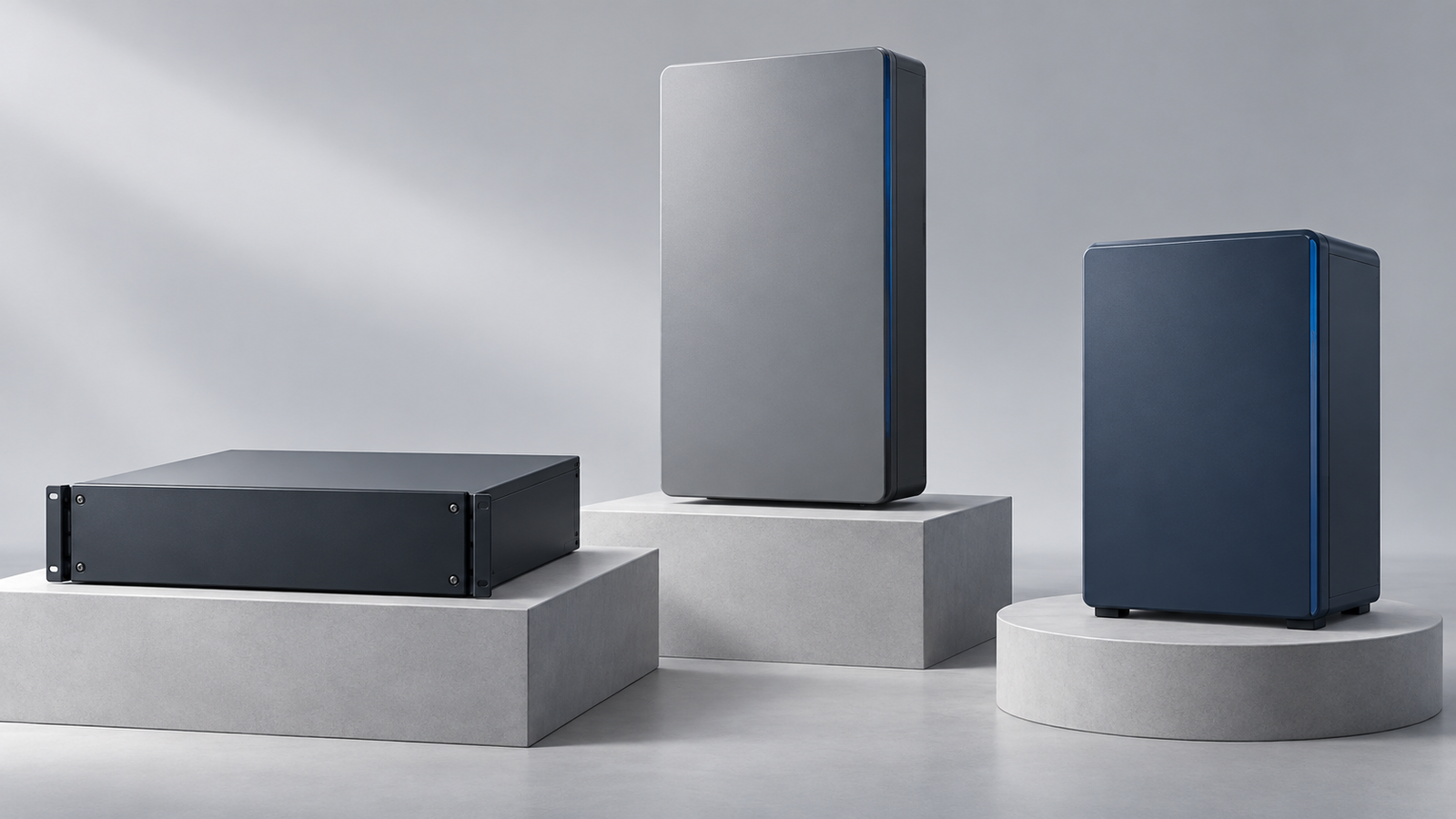
Same voltage class. Different physical needs.
- Server rack
- Check rack dimensions, rails and service access.
- Wall-mount
- Check approved mounting, support and clearances.
- Standalone
- Check enclosure, placement and system requirements.
Editorial explanation, not a product photograph, performance test or installation design.
What “48V” means on a battery listing
Many lithium iron phosphate (LiFePO4) products marketed for 48V systems use a nominal voltage of 51.2V. For example, 16 cells in series at 3.2V nominal each total 51.2V. Product naming may still say “48V” because the battery is intended for a 48V-class system. Always compare the actual voltage range, charging limits, and model-specific documentation—not just the marketing label.
Energy capacity is a separate specification. A 51.2V, 100Ah battery is nominally 5,120Wh (5.12kWh), while a 48V, 50Ah product is 2,400Wh (2.4kWh). Rated capacity does not by itself tell you how much energy is available to your loads; usable energy, reserve, conversion losses, temperature, and the battery’s operating limits matter.
Three common 48V battery formats
- Server-rack batteries: Rectangular modules intended for a rack or cabinet. They may include a display or monitoring, BMS communication ports, and parallel expansion. Confirm the exact enclosure dimensions, mounting method, accessory requirements, and the manufacturer’s list of supported configurations.
- Wall-mount batteries: Enclosed units designed around a wall-mounted or floor-standing installation. They may be easier to place where a rack is not wanted, but dimensions, weight, service clearances, and mounting requirements still need to be checked against the product manual.
- Standalone batteries: A broader category that can include compact cases or products intended for a specific system. Do not assume a battery is rack-compatible because its voltage and capacity resemble a rack module.
Compare the format—not just the voltage label
Use this table to narrow the physical format before comparing exact products. The enclosure alone does not establish energy capacity, an outdoor rating, expansion support or inverter compatibility. Confirm each item in the documentation for the battery revision you would actually receive.
| Format | When it may be worth considering | What to verify before ordering | Do not assume |
|---|---|---|---|
| Server-rack module | A stationary system where a compatible rack and service space can be planned together | Module dimensions and weight; approved mounting/support; cabinet fit; accessories; documented expansion limits | A generic rack description means it fits any cabinet or works with any other module |
| Wall-mount format | A site with space for the model’s approved mounting arrangement | Supported mounting method; structural requirements; weight; service clearances; permitted location | A slim enclosure can be mounted on any wall or installed outdoors |
| Standalone format | A different placement or capacity requirement that suits an exact model | Permitted orientation and support; enclosure rating; voltage/current limits; required external equipment | A freestanding battery is an all-in-one portable power station |
Physical fit and electrical compatibility are separate decisions. Ask the supplier to identify the supported battery, enclosure and inverter combination when the documentation is unclear.
How examples differ
These examples illustrate why specifications should be compared by model and format. ECO-WORTHY’s Cubix100 is marketed as a 48V, 100Ah server-rack battery with 5,120Wh listed energy, Bluetooth/Wi-Fi monitoring, CAN/RS485, and a 10-year limited warranty. Check current U.S. availability and the exact version on the seller’s listing; our Cubix100 review separates version checks from dated stock observations. VEVOR’s model LPS48100-B is listed at 51.2V, 100Ah, 100A maximum charge/discharge current, over 6,000 cycles, and RS485/CAN communication. Renogy’s 48V 50Ah Smart LiFePO4 is a different, smaller standalone-format option at 2,400Wh with self-heating and parallel expansion up to eight units, according to its current product page.
Those manufacturer specifications are not equivalent to an independent lab test or a compatibility guarantee. Models and product versions can change, and two batteries from one brand may use different communication protocols or have different charging, temperature, and warranty limits.
A practical comparison checklist
- Capacity: Compare nominal and usable Wh or kWh, and check how the manufacturer defines each figure.
- Voltage window: Match the battery’s documented operating and charge limits with the system manufacturer’s requirements. “48V” alone is not enough.
- Current limits: Read the continuous charge and discharge limits, not just a short-duration peak, and make sure they fit the intended system design.
- BMS communications: If a system relies on CAN or RS485 communication, check the exact battery and inverter models, protocol, firmware, and manufacturer compatibility list. A shared connector type does not prove the devices can communicate.
- Form factor: Verify product dimensions, weight, rack unit height, rails, cabinet depth, and service access. Battery and rack/cabinet are separate purchases unless a bundle explicitly includes both.
- Temperature and warranty: Check charge and discharge temperature limits, any low-temperature charging behavior, cycle-life test conditions, warranty exclusions, and the warranty term for the exact model.
- Documentation: Find the current user manual, product certificate or listing, and written compatibility guidance before buying.
Who may prefer each option?
A rack battery may suit a planned modular storage system when the rack, clearances, and supported communication setup are documented. A wall-mount unit may suit a site where its specified mounting arrangement and service space are available. A smaller standalone unit can be worth comparing when its capacity better matches the load or the user needs a different enclosure. These are selection considerations, not installation instructions.
Frequently asked questions
Is a 48V solar battery always a 51.2V battery?
No. “48V” can describe a product class rather than one exact nominal voltage. Read the model’s specification sheet for its nominal voltage, operating range and charge limits. Do not transfer the 51.2V rating of one LiFePO4 model to every battery sold under a 48V label.
Should I compare batteries in amp-hours or kilowatt-hours?
Use energy in Wh or kWh when comparing products with different nominal voltages, and distinguish nominal from usable energy. Nominal Wh equals the listed nominal volts multiplied by Ah. Two batteries with the same Ah rating can store different nominal energy when their voltages differ. This calculation does not establish delivered AC energy or continuous power.
Does a larger enclosure mean more storage capacity?
Not reliably. Read the capacity specification rather than judging the enclosure. Dimensions describe physical fit; stored energy and operating limits are different specifications. The conceptual illustrations on this page are not to scale and cannot be used to compare product capacity.
Does a wall-mount battery save space compared with a rack?
It depends on the exact battery, mounting arrangement and required access. Compare the full footprint—including the manufacturer’s service clearances—with the rack or cabinet alternative. Neither format is automatically the best choice for every room or installation.
Can I expand a 48V battery system later?
Only within configurations supported by the relevant manufacturers. Check supported models and revisions, maximum module count, communication requirements and installation limits before buying. Similar voltage and chemistry do not establish that mixed batteries can be combined safely or that expansion is permitted.
Is buying the battery enough for home backup power?
No. A standalone storage battery is not a complete home-backup installation. The required inverter, charging equipment, protection and transfer arrangement depend on the intended system and applicable requirements. This guide helps with product selection; qualified professional help and exact equipment documentation are needed for system design and installation.
Continue with the right buying guide
- Server-rack battery buying checklist — investigate documentation and selection requirements if a rack format is on your shortlist.
- 48V-class battery comparison — compare the researched product examples after defining your requirements.
- Battery rack and cabinet fit guide — separate module selection from enclosure planning.
Before choosing a battery
Estimate daily energy and autonomy first, then compare batteries using usable capacity and documented operating limits. Review the current manual for the exact model and ask the battery and inverter manufacturers to confirm compatibility in writing if the product pages are unclear. Installation, protection, wiring, and code requirements should be addressed by a qualified professional and the applicable local authorities.
Specifications checked: September 30, 2026. Product availability, prices, specifications, compatibility information, and warranty terms can change; verify them on the manufacturer’s current listing before purchase.
Manufacturer references: ECO-WORTHY Cubix100 listing; VEVOR LPS48100-B listing; Renogy 48V 50Ah listing.