
A solar kit for a shed should be chosen around what you need to power, not the largest number on the product title. Panel watts, inverter watts and battery storage describe different things. A bundle can also leave you with installation-specific equipment to purchase separately.
This guide compares two U.S. kit families and explains the buying questions to resolve before ordering. It is research based on seller listings and manufacturer documents, not a hands-on test or an electrical design.
Affiliate disclosure: SolOffGrid may earn a commission from qualifying purchases through links in this guide, at no additional cost to you. Links do not change the limitations of the equipment or our research.
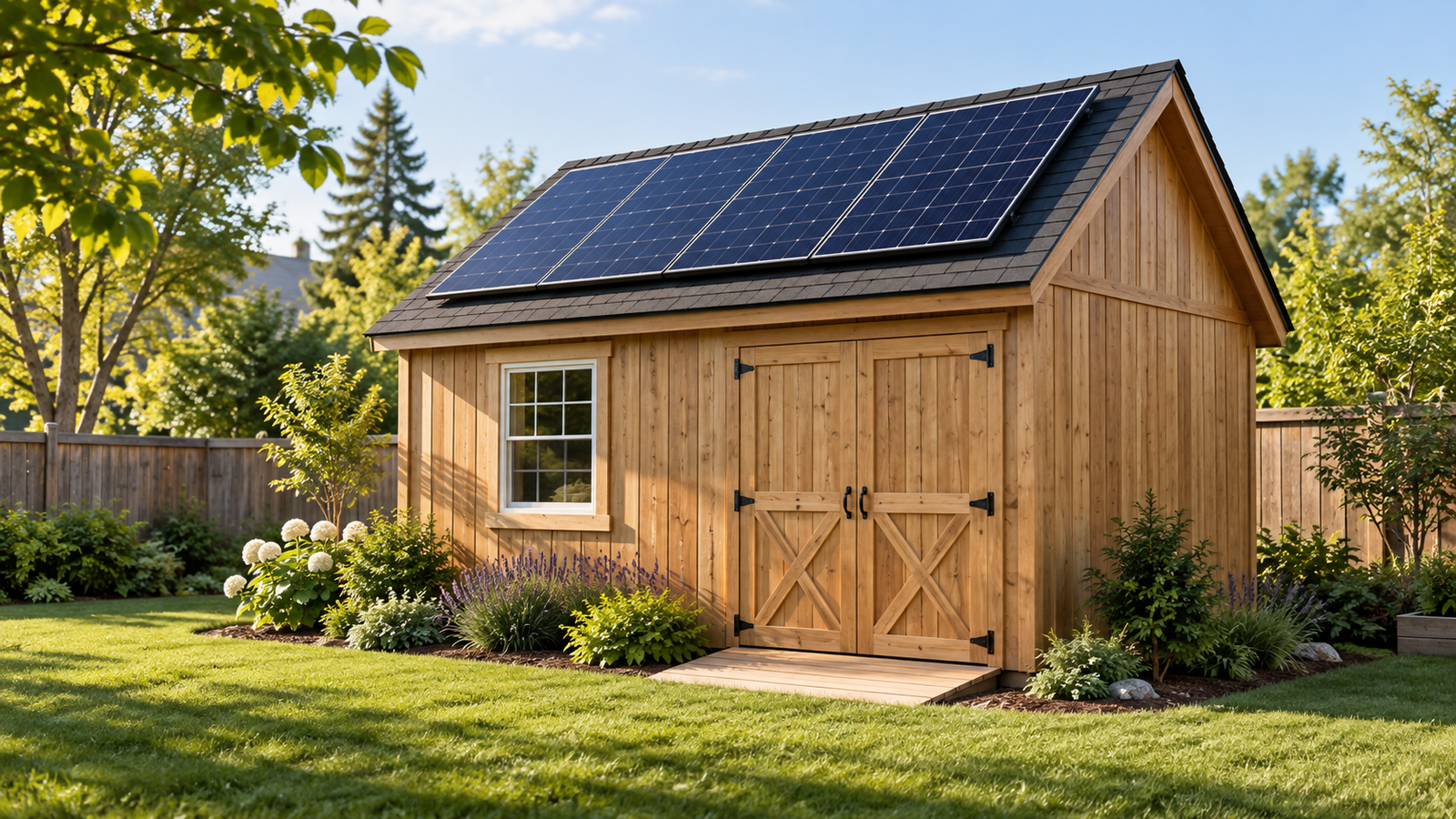
Quick answer: what should a shed solar kit include?
A battery-based solar kit typically needs panels, a compatible charge controller and battery storage. An inverter is needed for AC loads. Check the selected bundle, mounting equipment and installation-specific protection: the word “complete” does not mean every part of your project is included.
Before comparing products, decide whether you need occasional lighting and charging, regular daily power, or equipment with demanding startup loads. These are different projects.
Compare the exact kit variant, not just the brand
The following observations were checked on October 8, 2026. Prices, package contents and available variants can change. These are comparison candidates, not a ranking of the best products on the market.
| Buying detail | ECO-WORTHY 400W kit: selected battery/inverter option | Renogy 400W workshop/shed kit: selected lithium option |
|---|---|---|
| Kit identifier | US-L02M100N-MCWMZIUS1000L100-4 | RKIT400BD-R40D4-LCFP3-P3-US |
| Advertised panel array | 400W | 400W |
| Selected storage label | 1.2kWh lithium | 3.6kWh Pro Series lithium |
| Selected inverter label | 1.1kW | 3000W |
| Displayed product price | $799.99 | $2,499.99 |
| Main distinction | Smaller advertised storage and inverter output | Larger advertised storage and inverter output with the same panel watts |
| Before ordering | Confirm the battery revision and its cold-weather charging requirements | Confirm the exact Pro battery model and included accessories |
Sources: ECO-WORTHY selected product variant and Renogy workshop/shed listing.
Neither displayed price is a quote for a finished installation. We did not test checkout, delivery to your ZIP code or a purchase. Do not compare a battery-free option’s starting price with a package that includes storage and an inverter.
Check the ECO-WORTHY 1.2kWh / 1.1kW kit option →
Check the Renogy workshop/shed kit and selected battery option →
Recheck the option after opening either link. The Renogy link reaches the kit family rather than a fixed variant URL.
Why 400W of panels does not mean a 400W limit for everything
Panel watts describe the array’s rated power under specified test conditions. Battery watt-hours describe stored energy. Inverter watts describe output power capability, subject to its operating limits.
A larger inverter does not create extra solar energy. A larger battery can store more energy but does not make a same-size array recharge faster. Actual daily production and runtime depend on your location, shade, season, loads and system losses.
For preliminary storage assumptions, use our solar battery calculator. It is a planning estimate, not a design approval.
List your loads before choosing a package
Write down the devices you want to use, their power requirements and how long they operate. Include standby equipment that may run while the shed is empty.
For motors and other demanding equipment, check startup requirements as well as continuous consumption. A tool that fits within an inverter’s continuous rating can still need more starting power than the complete system can supply. Do not assume every shed kit can operate a heater, compressor or workshop machine.
Bring the appliance information and your proposed kit to a qualified installer when the project involves permanent wiring. This guide does not provide cable sizes, fuse values or building-circuit connection instructions.
Check cold-weather charging and expansion limits
Battery features are model-specific. The ECO-WORTHY 12V 100Ah sheet linked by the seller lists no self-heating and no low-temperature charging protection. Confirm the supplied battery revision before relying on it in a cold shed; do not assume its BMS makes freezing-weather charging safe. Manufacturer battery sheet.
The Renogy Pro RBT12100LFP-BT manual permits parallel connections only. Its self-heating feature also has charging-current conditions. Those statements apply to that battery model, not every battery bearing the same brand. Manufacturer Pro Series manual.
Do not plan a future voltage change by simply putting these Pro batteries in series. Confirm the controller, battery, inverter and expansion arrangement as a system.
What costs might be outside the advertised kit price?
Ask for an itemized list rather than assuming you need to buy everything below. Your installation may require mounting hardware appropriate to the structure, suitable protection and disconnects, extra cable length, weather protection, permits or professional labor. What is included varies by package and location.
Also check shipping, return conditions and support for your destination. A continental-U.S. policy should not be treated as proof of delivery to every state or address.
For the wider buying context, browse our Solar Kits section and Solar Panels guides.
Questions to ask before ordering
- What exact battery and inverter models come with this selected SKU?
- Is the documentation current for those revisions?
- Which required accessories are included, and which depend on my installation?
- Can the complete system handle my devices’ startup and continuous requirements?
- What charging-temperature protections does the supplied battery actually have?
- Will the seller ship every component to my ZIP code, and how are multiple packages handled?
Frequently asked questions
Can a solar kit power a shed at night?
A battery-based system can supply stored energy when the sun is unavailable, provided sufficient usable storage remains for the loads. Panel watts alone do not establish nighttime runtime.
Is a 400W solar kit enough for my shed?
The label alone cannot answer that. Compare daily energy needs, seasonal production, battery storage and startup loads. Both candidates above advertise the same panel watts but different storage and inverter sizes.
Does a complete kit include installation?
Not necessarily. Confirm the itemized package, installation-specific equipment and labor separately. A product bundle is not proof that the finished project meets local requirements.
Is battery capacity in kWh the same as usable AC energy?
No. Nominal stored energy does not account for all operating limits and conversion losses. Do not divide an advertised storage number by appliance watts and present the result as guaranteed runtime.
Is a portable power station the same as a fixed shed kit?
No. An integrated portable system and a component-based installation have different buying and installation considerations. See our Portable Power guides before choosing between those approaches.
Bottom line
Choose the package only after the selected variant, load requirements, climate and missing project costs are clear. The lower-price ECO-WORTHY option and the larger-storage Renogy option are not interchangeable just because both advertise 400W of panels. If the seller cannot confirm the equipment revision or a critical operating limit, resolve that question before buying.