
Affiliate disclosure: SolOffGrid may earn a commission if you buy through the affiliate links below, at no extra cost to you. Our comparison is based on manufacturer documentation, not hands-on testing.
A solar kit with an inverter can bring together the panels, charge controller, batteries and AC power conversion you need to start planning an RV system. It does not automatically solve roof mounting, circuit protection, shore-power integration or installation. Compare the exact package, not just the largest wattage in its name.
How to use this comparison: We compare two selected US-store packages, not every kit on the market. This is manufacturer-document research, not a hands-on test or an installation design. Product revisions, prices and shipping eligibility can change.
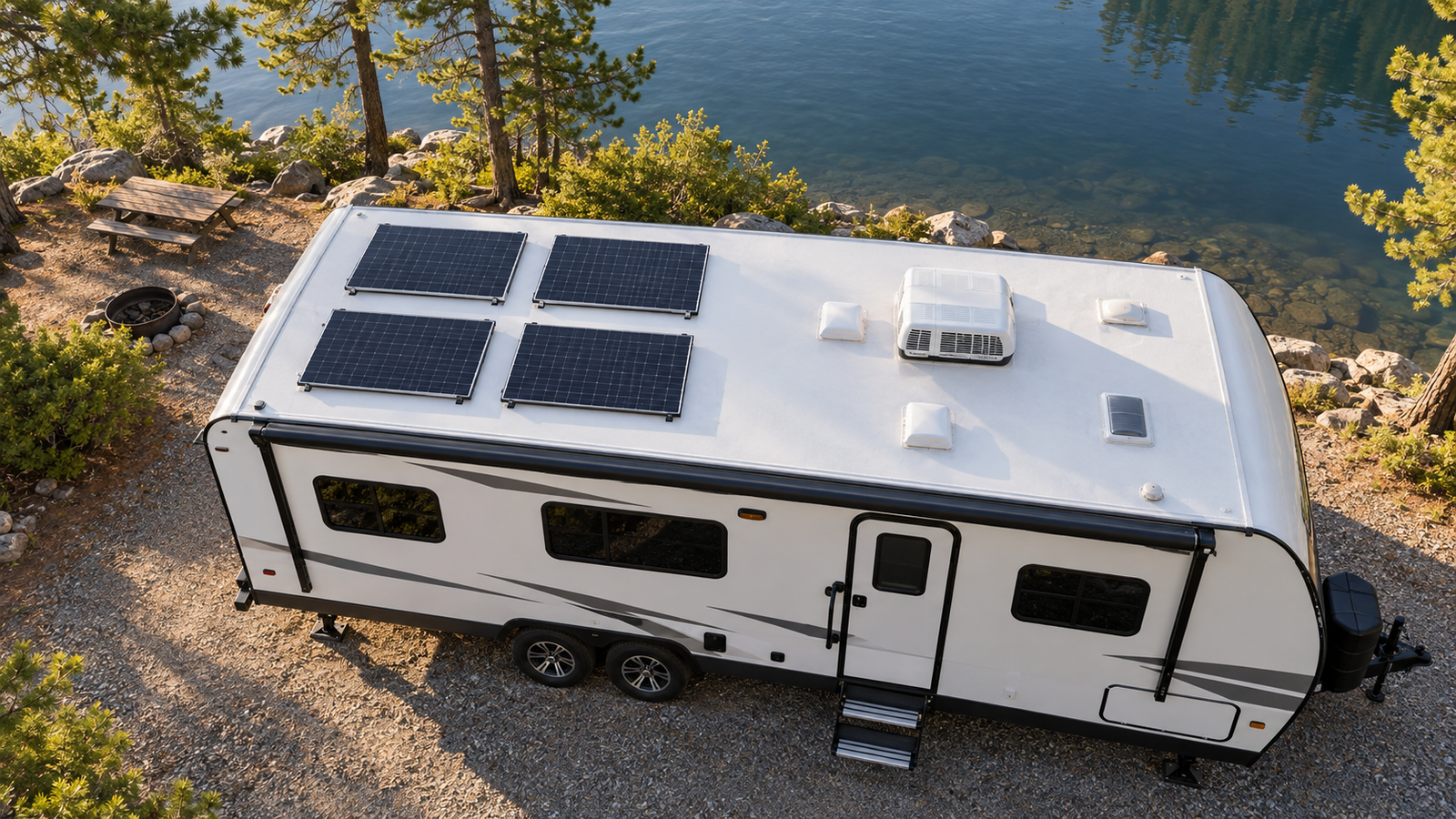
Do you need an inverter only or a solar kit with batteries?
An inverter turns battery DC power into AC power for compatible appliances. A solar charge controller manages charging from the panels. These functions are different, and neither component should be confused with a shore-power battery charger or an automatic transfer system.
- You already have a suitable battery bank: evaluate the missing component rather than replacing the whole system. Check voltage, discharge capability, protection and the existing charging equipment first.
- You are starting a permanent roof-solar system: a package with panels, batteries and an inverter can simplify the shopping list. It still needs an RV-specific installation plan.
- You want movable power: a portable power station is a different buying route. Do not assume that a permanently wired kit will give you the same setup experience.
If you only need a smaller panel-and-controller starter package, our Renogy 200W RV solar kit guide explains that option. It is not equivalent to either battery-and-inverter package below.
What is included in these two 400W RV solar kits?
The selections below both list four 100W panels, two 100Ah lithium batteries and a 2000W inverter. Those headline numbers make a useful starting comparison, but do not prove identical battery features or installation requirements. Select the named variant on the seller’s page.
| Item | Renogy | ECO-WORTHY |
|---|---|---|
| Package identification | RKIT400DLP2-US; lithium Bluetooth/self-heating option | US-L02M100N-MCWMZIUS2000L200-4A; variant 43984171925753 |
| Panels | 4 × 100W | 4 × 100W |
| Charge controller | Rover 40A MPPT | 40A MPPT; confirm current model |
| Storage listed | 2 × 12V-class 100Ah lithium | 2 × 12V-class 100Ah LiFePO4 |
| Inverter listed | 2000W, 12V, pure sine wave | 2000W, 12V, pure sine wave |
| Accessories highlighted in the box list | Mounts, branch connectors, panel/controller and battery cables, specified fuses, BT-2 | Mounts, branch connectors, panel extension and tray cable |
| Observed selected price | $2,599.99 | $1,399.99 |
| Important variant trap | The AGM option is a different battery selection. | The lower-priced “None” option is not this battery-and-inverter package. |
Prices are a dated observation, not an installation quote or a current-price guarantee. Verify shipping, tax, stock and the complete bill of materials before paying. An accessory not named in a box list is not confirmed included; it is not necessarily confirmed absent.
Check the original Renogy US kit (affiliate) and the ECO-WORTHY 2kW / 2.4kWh option (affiliate). Select the Renogy lithium Bluetooth/self-heating option; its AGM option is a different package. The ECO-WORTHY link opens the selected 2kW / 2.4kWh variant. Recheck your selection and delivery eligibility before ordering.
Renogy vs ECO-WORTHY: which differences matter for your RV?
Cold-weather charging and monitoring
The Renogy option is sold with Bluetooth and self-heating batteries. Its linked Pro-series battery manual identifies RBT12100LFP-BT and says heating needs a stable charging current greater than 4A for each battery in a parallel bank. Do not interpret self-heating as unlimited cold-weather charging regardless of available charging power. Confirm the supplied battery revision and follow its manual.
For ECO-WORTHY, the download is labelled as a low-temperature battery manual, but the linked data sheet marks low-temperature charging protection and self-heating as “No.” That documentation mismatch is not enough to establish the features of the current shipment. Ask for the exact battery model and current manual if cold-weather use affects your decision.
Protection and integration are separate from the headline price
Renogy lists more named accessories, while ECO-WORTHY has the lower observed package price. Neither fact alone establishes better installed value. An installer should identify the cables, isolation, overcurrent protection, mounting materials and labor required for your actual RV.
Do not mistake the controller-side fuse for inverter-battery protection. The linked Renogy P2 inverter manual discusses the battery-side fuse separately. Likewise, a set of panel brackets does not establish that a roof is structurally suitable or that every sealing material is supplied.
Will 400W of solar support a 2000W inverter?
The ratings describe different things. The solar array’s 400W is rated generation under test conditions; the inverter’s 2000W describes its rated AC output capability. Batteries can provide power above the panels’ instantaneous output, but their stored energy is finite.
For a transparent planning example, assume four peak-sun-hours and a combined usable charging factor of 75%. Then 400W × 4 hours × 0.75 gives 1,200Wh for that hypothetical day. The hours and loss factor are assumptions, not a prediction for your campground. Shade, weather, temperature, roof orientation and charging limits can change the result.
Do not compare that daily energy with an appliance’s wattage alone. An appliance drawing 100W for ten hours uses 1,000Wh before conversion losses; a 1000W appliance used for six minutes uses 100Wh before losses. Add daily consumption, allow for reserve and losses, and assess starting power separately.
Can this kit power your RV outlets or air conditioner?
That depends on the appliances, their starting behavior, the battery bank and how the RV’s AC circuits are integrated. A 2000W label is not a promise that an air conditioner will start, keep running overnight, or leave enough energy for other loads.
The Renogy P2 manual requires qualified installation and warns against connecting its AC output directly to a panel also supplied by utility power or a generator. Do not backfeed shore power or improvise a connection between sources. Have a qualified RV electrical professional assess isolation, grounding and any transfer arrangement required.
These package lists do not establish an included automatic transfer system or alternator charger. Treat those functions as separate verification questions, not automatic benefits of a “complete” kit.
What should you verify before ordering?
- Exact components: request the panel, battery, controller and inverter model numbers for your selected variant.
- Your energy budget: list continuous loads, hours of use and motor-start demands. Include poor-weather days.
- Roof fit: measure usable space around vents, confirm roof construction, weight limits, mounting and sealing requirements.
- Battery and charger compatibility: have the existing RV converter, other charging sources and battery installation reviewed.
- Protection and wiring: ask for an installation-specific parts list, including what the package does not cover.
- US delivery and support: confirm eligibility for your ZIP code, returns and warranty for the exact components.
Start with our RV solar planning guide and RV panel-mounting guide for the surrounding planning decisions. A shopping comparison should support that process, not replace it.
Which buying route makes sense for you?
Consider the Renogy lithium option if its documented monitoring/heating features match your priorities and you can verify the supplied models. Consider the ECO-WORTHY option if the lower initial package cost matters and the seller resolves the component and cold-weather questions to your satisfaction. Neither is a universal winner.
If you need unattended whole-RV integration, substantial air-conditioning use, or a system requiring almost no installation, pause before ordering either. Establish those requirements first; buying extra components afterward may erase the apparent price advantage.
Frequently asked questions
Does a complete solar kit include everything for installation?
Not necessarily. The phrase describes a package, not a guarantee that it covers your RV’s mounting, circuit protection and connection to existing electrical systems. Obtain an installation-specific bill of materials.
Is a 2000W inverter the same as 2000W of solar?
No. Inverter output capability and solar generation are different ratings. Here the listed array is 400W, and batteries bridge the difference only within their discharge and energy limits.
Can I use my existing RV battery or converter?
Only after confirming compatibility. Battery chemistry, voltage, allowable charging and discharge, and the converter’s charging settings all matter. A 12V label alone is insufficient.
Can I connect the inverter directly to my shore-power panel?
Do not connect it to a panel simultaneously supplied by shore power or a generator. The appropriate integration and source isolation must be designed and checked by a qualified professional.
Do these packages include alternator charging or automatic transfer?
The compared box lists do not establish those features. Ask the seller and installer what additional equipment is required instead of assuming it is included.
Sources and how this comparison was prepared
We reviewed the selected package listings and manufacturer downloads. We did not install these systems, measure output, verify a shipment or complete a checkout. Where a listing and download differ, the guide identifies the uncertainty rather than choosing a convenient specification.
- Renogy Pro battery manual, supplied PDF version A1; heating and connection limitations.
- Renogy P2 inverter manual; installation warnings and model-specific specifications.
- Renogy Rover Li manual, version B1; 40A-column specifications. Its lithium system-voltage selection requires manual setting.
- ECO-WORTHY linked battery data sheet; limitations of the published cold-temperature information.
- ECO-WORTHY inverter manual; verify the supplied revision.